Paramount UFC Broadcast Deal and UK Betting Impacts
 Available in US
Analyzing Live Odds Impacts from the Paramount UFC Deal
A friend who covers MMA for a British outlet called me the morning of 12 August 2025 — the day the Paramount-UFC deal broke — and asked what it meant for UK fans. The honest first answer was “less than people think”. The second, longer answer was “but some of it matters a lot.” Both are still true seven months on. The deal is the biggest UFC media-rights shift in the promotion’s history, but its UK-facing implications are filtered through the independence of British broadcast rights.
Paramount and CBS signed a seven-year agreement with TKO Group Holdings to carry UFC content starting in 2026, at a total value of $7.7 billion. The structure folds the US pay-per-view calendar into the broader broadcast schedule — US fans no longer pay per event as the exclusive access path — and shifts PPV economics into subscription and advertising economics. For TKO the deal is transformative. For UK fans it is indirect but material.
This piece works through the deal’s mechanics, what ending US PPV means for global UFC economics, what the implications are specifically for UK viewers and bettors, and why fighter-pay dynamics matter for betting markets even though bettors are not directly involved in the fighter economics. The companion piece on where to watch UFC in the UK covers the practical viewing side; this piece is the strategic picture.
The Seven-Year, $7.7bn Deal in Plain English
The headline numbers matter. $7.7 billion over seven years averages out to roughly $1.1 billion per year — a substantial step up from the preceding ESPN deal in the US market. The agreement runs from 2026 through 2032, with an option structure that could extend further depending on performance milestones. The deal covers US rights only; UK rights remain with TNT Sports under a separate agreement.
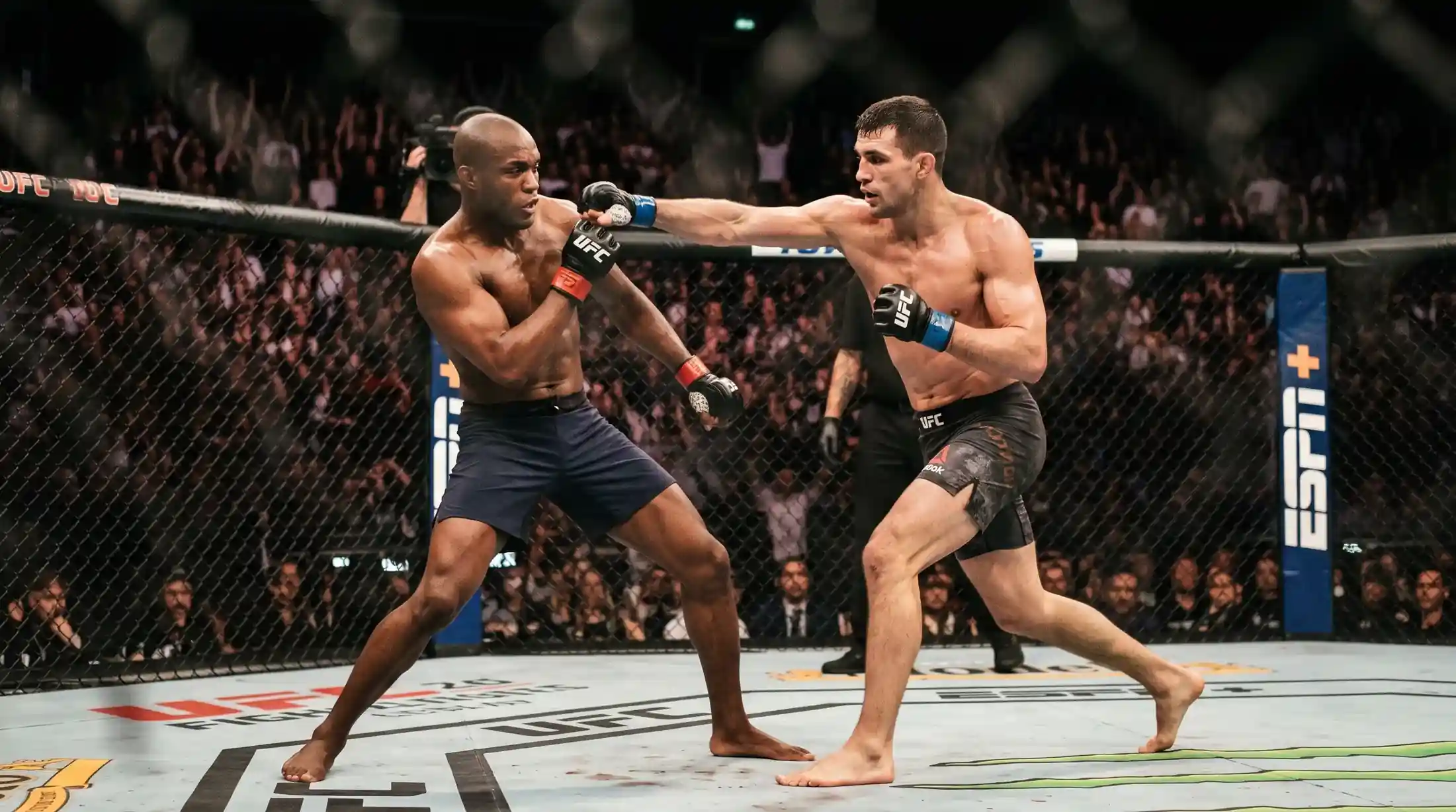
The content structure shifts significantly. UFC numbered PPV events — UFC 326, UFC 327 and onward under the new regime — move from pay-per-view to CBS linear broadcast as part of the Paramount deal. Fight Nights continue on Paramount+ streaming. The entire US live schedule becomes accessible through combined CBS linear plus Paramount+ subscription, replacing the previous “subscription plus PPV purchase” two-layer model.
The early signals from the first Paramount-era cards are meaningful. UFC 326 on CBS in March 2026 drew an average of 2.47 million viewers over the two-hour linear window, peaking at 3.21 million — the largest UFC audience on linear TV in the US since December 2016. The number validates the premise of the deal: removing the PPV paywall expanded audience reach substantially, and the resulting broadcast scale justifies the subscription-plus-advertising economics the deal is built on. Whether those audiences sustain across cards without marquee draws is the open question for years two and three of the agreement.
From UFC’s side, the strategic logic is visibility over per-event revenue. The 2025 TKO financial results captured the framing: UFC 2025 revenue came in at $1.502 billion with a 57% adjusted EBITDA margin. The promotion’s corporate infrastructure is profitable enough that trading PPV per-event margins for broader linear audience — and the long-term fighter development, sponsorship and merchandising uplift that comes with mainstream exposure — is a calculated long-term bet. The short-term revenue mix changes; the long-term commercial trajectory improves through mainstream audience acquisition.
The End of the PPV Era for US Fans
The most concrete change for US fans is the disappearance of the individual PPV purchase. UFC 326 was available to any CBS viewer in the US at no additional cost beyond existing cable or Paramount+ subscription. The fee-per-event model that defined UFC’s US economics for two decades ended with the transition.
The pre-deal context explained the commercial case for the shift. One media industry analyst writing shortly before the deal was announced noted: “ESPN paid UFC less money in [fiscal] Q3 of 2025 than Q3 of 2024 because of lower average buys per event. Translation: already bad PPV numbers got worse, year over year. UFC needs a superstar for these numbers to recover, with none in sight.” The analysis was accurate. US PPV buy rates had declined for several years, and UFC’s reliance on individual event economics was becoming increasingly fragile. The Paramount deal replaced the declining model with a stable subscription-and-advertising model that scales with audience reach rather than per-event purchase decisions.
The fighter side of the economics is more complicated and more contested. One former UFC co-founder framed the trade-off sharply: “The deal is good for everyone, except the fighters. UFC will have even more leverage over the top fighters and their agents during negotiations without the PPV sales pressure.” The argument is that fighters’ individual PPV shares were a negotiation leverage point that disappears with the PPV model, and replacing PPV economics with subscription economics concentrates commercial leverage further with UFC management.
A counter-view came from another MMA industry voice: “It gives fighters clear security that the UFC is around, driving business and events, and you need not worry that you’ll get fights and will get paid. That’s not true for every promotion.” The long-term stability of UFC as an organisation benefits fighters through guaranteed fight scheduling and sustained commercial infrastructure, even if the per-event PPV share disappears. The two views are not mutually exclusive — the deal does consolidate UFC leverage over individual fighters while simultaneously stabilising the overall commercial ecosystem fighters operate in.
UFC’s CEO commented on fighter pay specifically in the aftermath of the deal: “I can’t sit here right now and tell you, you know, it’s double, it’s one and a half, it’s triple. But, yeah, fighter pay is — yeah, it’s gonna be good.” The specificity is notable in the absence of specific commitments. Whether fighter pay actually improves materially under the Paramount era is the empirical question that will define how bettors view UFC-fighter alignment in the coming seasons.
What This Means in the UK (Rights Are Separate)
The UK picture is simpler than the US picture because UK UFC rights sit with TNT Sports under an entirely independent deal. UK fans do not suddenly get UFC access through CBS or Paramount+ — those platforms serve different territorial licence structures. The TNT Sports Box Office PPV model for UFC numbered events continues for UK viewers even as US PPV disappears.
UFC on TNT Sports remains the UK exclusive for live events — Fight Nights on standard subscription, numbered PPVs through TNT Sports Box Office at roughly £19.95 per card. UFC Fight Pass remains available for archive content. The UK viewing infrastructure does not change in 2026 based on the Paramount deal.
What does change, indirectly, is the scale of UFC promotional investment. A seven-year, $7.7 billion US deal funds promotional, marketing and event-production spending at a level that increases the quality and frequency of cards globally, including UK-hosted events. Expect more UFC London cards in 2026 and 2027 than the pre-deal schedule would have produced, with better promotional marketing around each. UFC has consistently demonstrated that increased commercial resource translates into increased event frequency and higher production quality, and the UK benefits from that uplift even without being part of the specific deal structure.
The broader UK audience effect is likely to be positive. UFC’s global fanbase already numbers over 688 million across broadcast platforms, and UK viewers form a meaningful slice of that engagement. Mainstream CBS audiences in the US translate into cultural reach that spills across English-language markets, and UK engagement patterns typically track US engagement with a lag of a few months. Expect UK UFC viewership — both live broadcast and betting-related digital engagement — to lift through 2026 as the Paramount effect amplifies global UFC visibility.
UK online gambling continues to grow at 7% year-on-year pace with 13.5 million monthly active online accounts, and MMA-category betting volume within that total will benefit from the audience uplift. UK bookmakers are positioning for expanded UFC engagement through the Paramount era with incremental investment in MMA product depth, though the UK operator response is gradual rather than step-change. The broader market dynamics are covered in detail in the piece on where MMA sits inside the UK remote betting market.
Why Fighter Pay Discussions Matter for UK Bettors
Fighter-pay dynamics sound like a corporate governance story rather than a betting story. They become a betting story when pay structures affect fighter behaviour in ways that translate into in-cage outcomes.
The specific mechanism is risk-reward calculation. Fighters earning bonus-heavy compensation packages — Performance of the Night, Fight of the Night, finish bonuses — have strong incentives to take risks during fights in pursuit of the bonuses. Fighters on fixed contract structures with less upside from bonuses have weaker incentives for risk-taking. The Paramount deal’s impact on bonus structures and fighter compensation models affects the aggregate risk-taking pattern across UFC rosters.
If the deal leads to expanded bonus pools — UFC has reinvested some of the additional revenue into fighter-pay structures historically, though the pattern is inconsistent — then finish rates across cards could rise as fighters pursue bonuses more aggressively. That shifts method-of-victory market dynamics toward KO/TKO and submission outcomes against decision outcomes, affecting how UK books price method markets and where value sits. Bettors who track bonus-pool announcements can anticipate method-distribution shifts before they fully price into UK markets.
The contrasting scenario is bonus-pool compression if UFC uses the additional revenue primarily for corporate reinvestment rather than fighter compensation. In that case fighter risk-taking patterns would stabilise or decline, producing slightly more decision-heavy method distributions and slightly more conservative fight strategies. UK book pricing models that assume historical bonus-pool-driven finish rates would become systematically too aggressive on finish lines.
Neither scenario has fully resolved as of early 2026. The first year under the Paramount deal is too short a sample to draw firm conclusions about either fighter-pay structures or the resulting method-distribution shifts. What is clear is that the deal changes the commercial context of UFC fighting in ways that matter for fight outcomes, and UK bettors who are tracking the relationships between financial structures and in-cage patterns will be better positioned than those treating the deal purely as a broadcast story.
The broader TKO executive framing captured the strategic significance: “2025 was a milestone year, underscoring the durability of our premium IP through record-setting live events and transformational global partnerships.” The durability framing matters for betting markets because stable, well-resourced promotions produce more predictable fight scheduling, better-prepared fighters, and more consistent pricing environments than financially unstable promotions. The Paramount deal reinforces UFC’s commercial durability, which feeds into every downstream market including UK betting.
The UK Betting Picture Through 2032
The seven-year horizon of the Paramount deal coincides with the next phase of UK MMA betting development. UK book investment in UFC coverage will continue expanding through the deal window. In-play infrastructure will improve. Prop market depth will expand incrementally. UK UFC card frequency will rise, possibly reaching three domestic events per year by 2028 or 2029 based on the trajectory of recent schedules.
None of this is dramatic step-change. The Paramount deal does not directly restructure UK UFC access the way it restructures US access. What it does is raise the floor of UFC’s global commercial presence, and UK betting markets benefit from that higher floor through sustained audience growth, operator investment and product expansion. The deal is a tailwind for UK MMA betting rather than a headwind, and bettors operating across the 2026 to 2032 window should expect the ecosystem to be healthier, deeper and more sophisticated than the pre-deal baseline.
Does the Paramount deal replace UFC Fight Pass globally, including for UK viewers?
No. UFC Fight Pass remains available as a distinct direct-to-consumer archive and development-card service, separate from the Paramount deal’s live-event focus. UK viewers can continue accessing Fight Pass alongside their TNT Sports UFC subscription. The Paramount deal covers US live rights and does not replace the Fight Pass archive product in the UK or any other market.
Will UFC UK cards move to CBS-linked UK broadcasters under the Paramount era?
No. UK UFC broadcasting rights remain with TNT Sports under an independently negotiated agreement. CBS-linked UK broadcasters — Channel 5, historically — do not hold any UFC rights and are unlikely to acquire them within the current rights-cycle windows. UK fans continue to watch UFC through TNT Sports across Fight Nights, PPVs via TNT Sports Box Office, and Fight Pass archive content.
Created by the ”mma Betting Online” editorial team.