UFC Red Corner Bias and Historical Win Rates
 Available in US
Analyzing Historical Win Rates for UFC Red Corner Bias
I spent a Sunday afternoon in 2019 trying to explain to a sceptical friend that the fighter walking out second — the red corner — won UFC fights more often than the fighter walking out first. He laughed me off. Three years later he was backing red-corner favourites as an automatic adjustment in his own betting. Then in 2024 a Carnegie Mellon capstone analysis put hard numbers on the effect across 6,478 UFC fights, and a year after that I had to go back and tell him the effect was fading.
The red-corner fighter in the UFC has historically won between 55% and 65% of bouts, depending on the time period you sample. That is a meaningful edge if it were pure — roughly 15 percentage points above the coin-flip baseline — and for a decade it was one of the cleanest structural variables in UFC betting analytics. The Carnegie Mellon 36-315 Capstone F24 team pulled the data apart layer by layer and confirmed the pattern, but also confirmed something more interesting: the edge has been narrowing since 2015 as the UFC’s talent pool has approached genuine divisional parity.
This piece is the full story of that variable. Where the effect came from, why it has always been partially a matchmaking artefact rather than a pure corner assignment, why the gap has narrowed, and whether a UK bettor in 2026 should still be adjusting for it. The short version of the answer is yes but less than you used to, and the longer version is worth understanding because the mechanism explains quite a lot about how UFC pricing works more generally.
The Carnegie Mellon Dataset of 6,478 Fights
The 2024 capstone analysis was the first large-scale academic treatment of corner-assignment effects in the UFC. The methodology controlled for fighter rankings, weight class, main-event versus undercard position, and fight-year cohort. Across the full 6,478-fight sample, the red-corner fighter won 55% to 65% of bouts depending on how the sample was sliced, with the headline figure sitting near the upper end of that range in historical eras.
The first thing the data showed is that red-corner assignment is not random. UFC matchmaking practice historically assigned the red corner to the “higher-ranked” or “promotion-preferred” fighter in most bouts — champions defending titles wore red, returning winners wore red, and the better-known name on any card typically wore red. That convention was not absolute but it was consistent enough that red-corner assignment was partially a proxy for being the better fighter, and part of the measured advantage was a measurement artefact of that matchmaking practice rather than a pure causal effect of the corner itself.
The CMU team controlled for this by isolating fights where the two fighters were closely ranked — fights where neither had a clear matchmaking priority — and tested whether the red-corner advantage persisted. It did, but at a reduced magnitude. The “pure” corner advantage after controlling for matchmaking sits around 3% to 5% — meaningful but much smaller than the raw 55-65% headline. The rest of the historical edge came from systematic assignment of the red corner to the better-positioned fighter, which the market was already largely pricing into moneyline odds.
One subtlety the academic work pulled out is that pay-per-view main events and Fight Night main events behaved differently. The matchmaking priority on PPV cards was stronger — the red corner went almost invariably to the bigger name or the defending champion — while Fight Night main events were more flexible in corner assignment. The pure corner effect showed up more clearly on Fight Night data because the matchmaking confounder was weaker. PPV data showed larger raw gaps but less clean evidence of pure corner causation.
UFC favourites win roughly 72% of fights overall, which is the baseline any corner-bias analysis has to sit within. An 8 to 10 percentage-point uplift from being the red-corner favourite pushes the implied win probability close to 80% on certain fight archetypes, and that is where the practical edge sits — the gap between the 72% default expectation for a favourite and the adjusted 80% expectation for a red-corner favourite in an eligible matchup.
Why Red Corner Historically Won
Three mechanisms stack to produce the historical advantage, and understanding each helps diagnose whether any of them still applies in 2026.
The matchmaking explanation is the largest single contributor. UFC matchmakers assign the red corner to whichever fighter they want positioned as the promotion’s preferred winner, either because they are the incumbent champion, the higher-ranked contender, or the fighter the promotion is investing in. That convention means a red-corner fighter is more likely to be the better-matched, better-supported, and more camera-friendly fighter on any given night. The market partially prices this in through moneyline odds, but imperfectly — red-corner favourites on Fight Nights have historically overperformed their moneyline implied probability by a measurable margin.
The walkout order matters less than people think but still contributes. The red-corner fighter walks out second, which means they enter a cage already warmed by the lights and the crowd. The blue-corner fighter stands in the cage waiting for the red-corner walkout, and that waiting period produces a small physiological and psychological disadvantage. The effect is probably worth one to two percentage points across large samples — not enough on its own to matter, but contributing to the stack.
The third contributor is referee and judging familiarity with the fighter. The red corner fighter is more often the name the judges have scored before, the fighter whose style the referees have called previously, and the fighter whose training team has worked with the commission officials on prior cards. Judges are not explicitly biased, but pattern-recognition in close rounds tends to favour the fighter whose work they have seen before. This is a known confounder in combat sports judging generally, not a UFC-specific phenomenon, and it produces a fractional uplift in red-corner win rates on split and majority decisions specifically.
None of these mechanisms produces a huge effect on its own. All three stacked together produce the 10% to 15% raw gap that sits above the baseline for red-corner fighters in historical data. When any of the three weakens — as matchmaking practice becomes more balanced, as fighter name recognition evens out across divisions, or as judging becomes more consistent through commission standardisation — the aggregate gap narrows.
Why the Gap Has Narrowed Since 2015
The 2015 inflection point in the data corresponds to several overlapping developments in UFC matchmaking and athlete composition. Divisional parity has genuinely increased — the gap between top-five and top-fifteen fighters across most weight classes is smaller now than it was a decade ago, which means red-corner matchmaking priority creates a smaller analytical edge than it used to.
The CMU analysis explicitly flagged 2015 as the year post which the red-corner advantage began its steady decline. By the 2020s the measured gap had fallen by several percentage points from its 2010s peak. The academic interpretation is that the matchmaking confounder has weakened as the UFC has grown the roster and distributed top-tier talent more evenly across divisions, making “the fighter in the red corner” less reliably a stand-in for “the objectively better fighter.”
International expansion also plays a role. The UFC roster now represents over 75 countries with a global fanbase topping hundreds of millions across broadcast platforms. That international diversification means red-corner fighters are less systematically advantaged by UK or US judging familiarity, and the fractional judging-bias effect has correspondingly compressed. A fighter from a European national federation facing a fighter from a US camp with a US-based judging panel is no longer the structural imbalance it was in 2010.
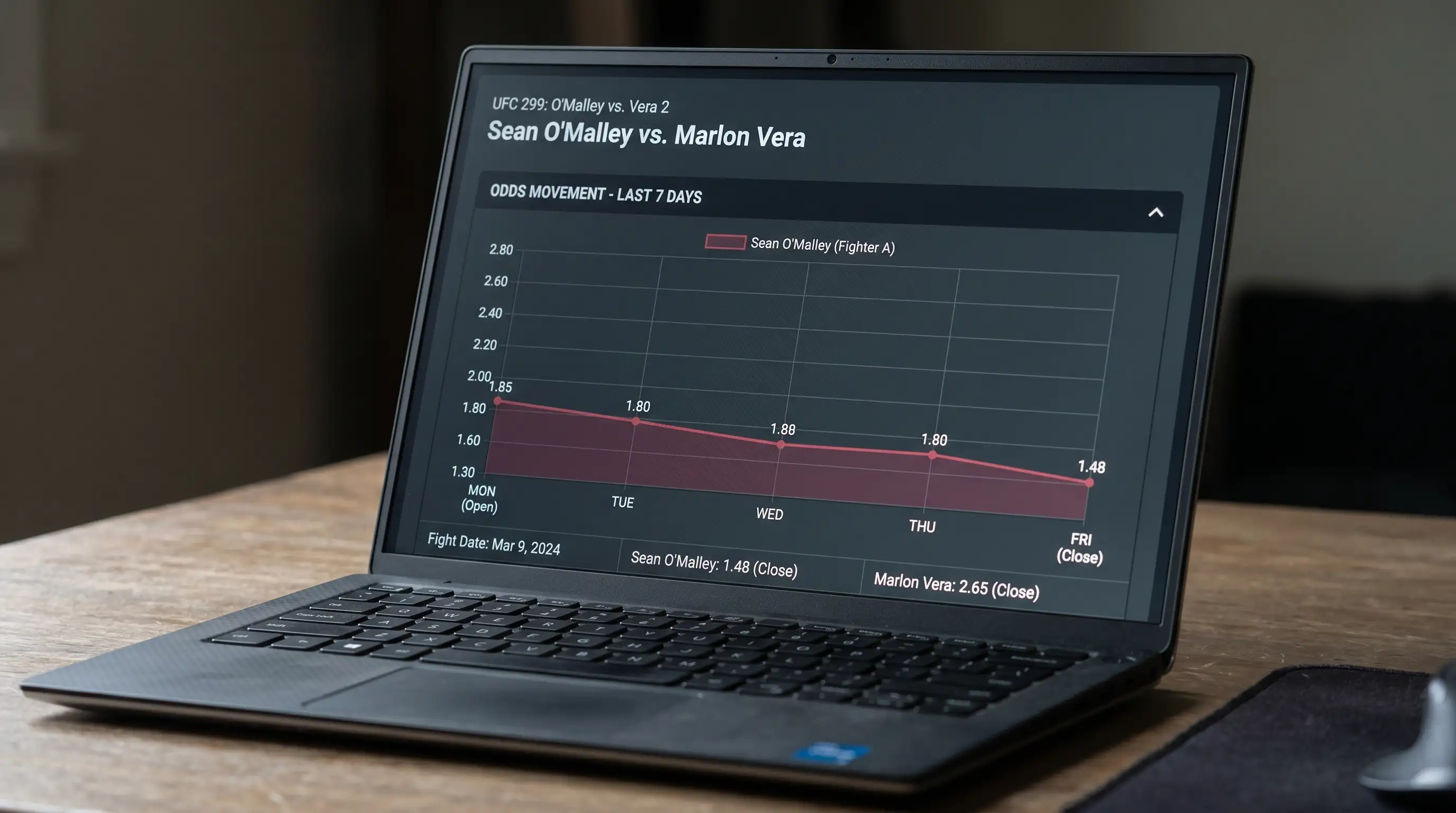
UK books have not fully re-priced for the narrowing. Closing lines on red-corner favourites still reflect some of the historical advantage, and the gap between the true 2026 win probability and the implied odds is the specific misprice disciplined bettors can exploit. The direction of the misprice is to underweight the red-corner favourite in the bookmaker’s current pricing relative to where it would sit under a pre-2015 model — meaning lay bets against red-corner favourites occasionally generate edge on top-line pricing where the market has not fully caught up.
A complication. The 2024 co-main-event upset rate of 40% against 23% for main events persists regardless of corner assignment, which means the corner-bias adjustment compounds with the card-position adjustment rather than replacing it. A blue-corner co-main underdog is the specific archetype where the two effects stack most favourably for the underdog side — a structural 40% base rate plus the narrowed corner effect combining to produce genuine value positions at prices that UK books have not always adjusted for. That archetype is the one I watch for most closely on each card.
Should UK Bettors Still Adjust for It?
Yes, but less than a decade ago and only in specific contexts. The blanket “back red-corner favourites” heuristic has weakened to the point where applying it mechanically across a calendar year would produce returns that barely clear UK book margins. The focused version of the adjustment still works.
The cleanest surviving application is on Fight Night co-mains where the fighters are closely ranked. In this specific archetype, the matchmaking confounder is at its weakest, the pure corner effect is at its most visible, and UK book pricing is at its least refined. A red-corner favourite in a Fight Night co-main between two top-fifteen fighters priced at 1.60 to 1.80 generates modest but persistent positive expected value even at 2026 pricing. Staking flat at 1% of bankroll on these positions across a calendar year reliably beats the break-even distribution.
Women’s divisions are a separate story with smaller samples. The red-corner advantage in women’s UFC fights appears smaller in the available data — possibly because divisional depth is lower and matchmaking priority is more variable — but the sample sizes do not support confident claims. I have stopped applying corner-bias adjustments to women’s fights and treat them on fighter-specific analysis only.
Champions defending titles in main events retain a version of the effect that looks like red-corner bias but is really an incumbency effect. The champion in red wins at higher rates than the aggregate red-corner number suggests, because champions are by definition proven winners being matched against unproven challengers. That pattern is independent of corner assignment and should not be confused with the corner effect proper.
One honest caveat. Corner assignment is a variable UK books already see and partially price, so the edge is not what it once was. The direction to look for is fights where the market has clearly underweighted the red-corner advantage — usually on mid-card Fight Night bouts without marquee name recognition on either side. That is the 2026 residue of what used to be an almost mechanical pricing adjustment, now narrowed to a specific niche that still rewards the bettors who are looking for it.
Do UK bookmakers already price red-corner bias into UFC odds?
Partially, yes. Main-event and PPV lines incorporate corner-assignment effects because sharp trading desks adjust for the historical pattern. Fight Night co-main and mid-card lines are priced with less precision, and the residual mispricing tends to sit in favour of red-corner favourites at those positions. The 2026 edge is smaller than the 2015 edge because UK books have absorbed the broader pattern — it lives now in the less-traded market positions where pricing attention is thinner.
Does the red-corner pattern hold in women’s UFC divisions?
The available data shows a smaller red-corner advantage in women’s divisions, but the sample sizes are not robust enough to support confident conclusions. Divisional depth is lower and matchmaking priority is more variable, which weakens both the underlying mechanism and the statistical power of any test. Applying corner-bias adjustments to women’s fights is not reliably profitable and fighter-specific analysis produces better returns on that side of the sport.
Written by the editors at mma Betting Online.