UK MMA Betting Regulation and Gambling Commission Rules
 Available in US
Table of Contents
- Implementing UKGC Reforms for MMA Betting Regulation
- The UKGC Licence: What It Actually Guarantees MMA Bettors
- From the 2023 White Paper to the 2025 Rulebook
- The Statutory Levy: What the 1.1% on Operators Funds
- The October 2025 Deposit Limit Prompt and What It Feels Like
- Light-Touch Financial Vulnerability Checks for UK Bettors
- Problem Gambling Rates: The Headline Numbers
- Tools at Your Disposal: GAMSTOP, Deposit Limits, Self-Exclusion
Implementing UKGC Reforms for MMA Betting Regulation
I have been covering UK MMA betting since 2015, and I have never seen a single twelve-month window rewrite the rulebook the way 2025 did. Three substantial reforms landed inside a calendar year — a statutory levy on operators, hard stake caps on online slots, and a new duty for books to prompt first-time deposits for a personal limit. If you were away on holiday for half of it, you came back to a different industry.
The reforms were not aimed at MMA bettors specifically. They were the slow, grinding output of the 2023 Gambling Act White Paper, shaped through consultation and legislated into effect across the spring and autumn of 2025. But the effect on British punters who bet UFC, Bellator, KSW and Cage Warriors cards is real: the account you opened in 2022 behaves differently now, the levy your book pays is baked into their margin whether they tell you or not, and the deposit prompt that appears the first time you fund a new site is legally mandatory rather than a voluntary nudge.
This piece is the regulatory map. I am going to walk you through what a UKGC licence actually guarantees, what the 2023 White Paper delivered by mid-2025, how the statutory levy reshapes operator economics, what the October 2025 deposit-limit prompt feels like in practice, how affordability checks work, where problem-gambling rates actually sit across Great Britain, and what tools you have as a bettor to manage your own activity. The headline numbers sit inside the wider UK MMA betting online playbook; this is the deeper regulatory cut.
One prefatory note. The Gambling Act 2005 remains the foundational legislation. Everything below is amendment, regulation and licence-condition tightening layered on top of that original statute. UK gambling law did not restart in 2025; it was extensively upgraded.
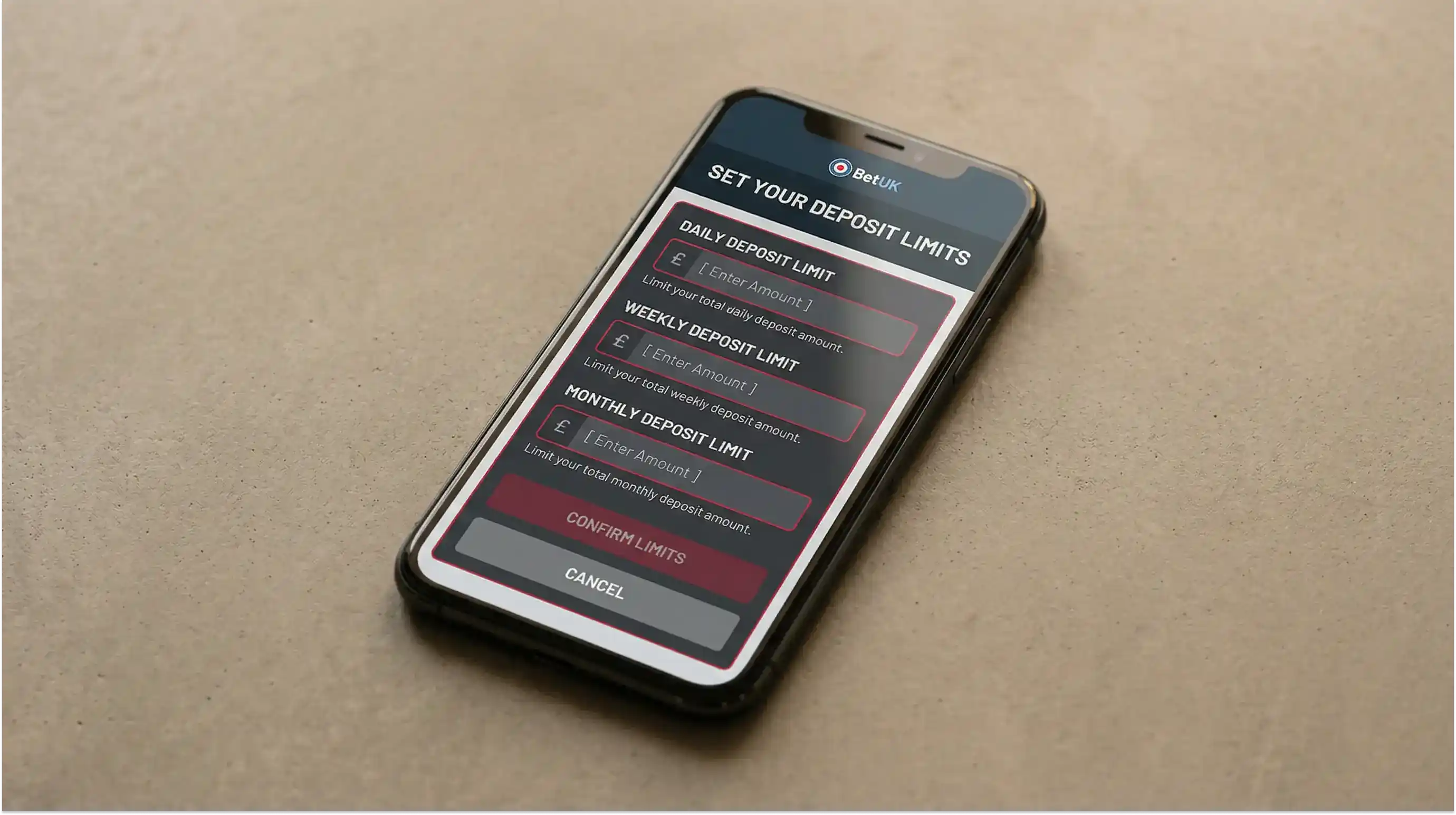
As part of the new safety measures, players must now navigate mandatory deposit limits on UK MMA betting sites upon registration.
The UKGC Licence: What It Actually Guarantees MMA Bettors
Picture the UKGC licence register for a second. As of 31 March 2025, Great Britain had 2,179 active licensed operators — down 3.7% year on year. Retail betting shops fell to 5,825, the eleventh consecutive quarterly decline. That shrinkage is not random; it is the tail of unlicensed or sub-scale operators exiting a market where the licensing bar is rising and the cost of compliance is climbing with it.
A UKGC licence is not a customer-service badge. It is a binding legal framework called the Licence Conditions and Codes of Practice — the LCCP — that defines exactly how a licensed operator must behave, what customer protections it must offer, and what happens when it fails. For a UK MMA bettor, the licence guarantees four practical things. First, dispute resolution through an approved Alternative Dispute Resolution provider, at no cost to you. Second, segregated customer funds or equivalent protection, so that your deposit is not lost if the operator collapses. Third, responsible-gambling tools including deposit limits, time-outs, self-exclusion and account-closure pathways, every one of which must be offered regardless of whether you ask. Fourth, adherence to the full set of advertising, bonus and verification rules that UKGC has tightened repeatedly since 2019.
Gross Gambling Yield tells you the economic scale of what that licence is regulating. The industry’s total GGY for FY 2024/25 was £16.8 billion, up 7.3% year on year. Remote Casino, Betting and Bingo — the online piece — contributed £7.8 billion, up a striking 13.1% YoY, and now accounts for 46% of the GB market. Remote betting GGY specifically was £2.6 billion, led by football at £1.3 billion, horse racing at £766.7 million, and MMA tucked into the “Other sports” category alongside tennis, golf and the rest. MMA’s share of remote betting turnover is material even when it is not reported as a standalone line.
What the licence does not guarantee is that any specific operator is good. It guarantees that they meet the minimum legal bar — which has risen substantially in 2025 — and that they can be held accountable when they fall short. Enforcement has teeth. Licensees caught breaching LCCP face financial penalties, formal warnings, operating licence reviews and in serious cases revocation. The UKGC publishes enforcement notices openly, and the list grew meaningfully through 2024 and 2025 as the Commission applied the White Paper-era rules to legacy operator behaviour.
The practical first-check for any UK MMA bettor is the public register, searchable free at gamblingcommission.gov.uk. Typing the trading name of any operator into that register shows the licence status, the account number, the legal entity that holds it, and the sectors it is authorised in. If that check fails — if the operator is not listed, or their status reads as revoked or surrendered — no deposit should happen. Full stop. The step is free and takes less than two minutes. The number of British punters who skip it anyway is one of the quiet ongoing problems of this market.
From the 2023 White Paper to the 2025 Rulebook
The 2023 Gambling Act White Paper was titled “High stakes: gambling reform for the digital age” and set out the most comprehensive overhaul of UK gambling rules in nearly two decades. It did not write law directly — White Papers never do — but it committed the government to a sequence of regulations, LCCP amendments and secondary legislation that would implement its recommendations over an eighteen-to-thirty-month window. That window delivered through 2024 and, decisively, across 2025.
The headline reforms that hit British MMA bettors sat in three buckets. Financial risk checks, stake caps on specific product types, and the introduction of the statutory levy funded by operators. All three landed within six months of each other through spring and autumn 2025.
The online slots stake cap came into force on 9 April 2025. Under the Gambling Act 2005 (Operating Licence Conditions) (Amendment) Regulations 2025, online slots are capped at £5 per spin for players aged 25 and over, and £2 per spin for players aged 18–24. This does not apply directly to MMA betting — slots and sports betting are different product categories — but it matters because many UKGC-licensed sites run both, and the stake caps have materially changed the cross-product risk profile those operators manage.
The statutory levy took effect on 6 April 2025 under the Gambling Levy Regulations 2025. Online-operator licensees pay 1.1% of their GGY as a mandatory contribution; land-based rates are 0.5%, 0.2% and 0.1% depending on sector. The expected fund for 2025–26 is £90–100 million, earmarked for research, prevention and treatment of gambling harms. Baroness Twycross, Minister for Gambling at DCMS, framed the policy in parliamentary debate: “The levy represents a watershed moment: a significant uplift in the investment dedicated to this area; greater government oversight; and a renewed commitment to further understanding, tackling and treating gambling harms.”
The third reform — the deposit-limit prompt, effective 31 October 2025 — is the one most UK MMA bettors feel personally, because it changes the sign-up experience at any new UKGC-licensed book. We unpack that in its own section below. In aggregate, the three reforms shifted the British gambling market from a voluntary framework of operator self-regulation with light-touch oversight to a regime of statutory financial obligations, consumer protections and regulatory enforcement that more closely resembles financial-services supervision than the on-course betting culture the sector grew out of.
The practical point for a British MMA bettor is that every UKGC-licensed book you have an account with is operating under a meaningfully stricter ruleset than it was at the start of 2025. Some of that tightness shows up as paperwork — more verification, more prompts. Some of it shows up as protection — genuinely harder to deposit in a spiral, genuinely harder for operators to ignore signals of harm. And some of it shows up in margins, because the 1.1% levy has to come from somewhere. If your average effective UFC betting margin with a particular book has widened quietly across 2025, the levy is one possible cause alongside ordinary commercial pricing.
The Statutory Levy: What the 1.1% on Operators Funds
The statutory levy is the reform British gambling operators fought hardest and lost most decisively. For years the industry funded research, prevention and treatment through voluntary contributions to GambleAware — a system that produced real work but also reliably generated headlines about some operators under-contributing relative to their market share. The Gambling Levy Regulations 2025 ended the voluntary framework and replaced it with a mandatory percentage-of-GGY contribution ring-fenced by DCMS.
The rates landed at 1.1% for remote operators, 0.5% for larger land-based operators, and lower tiers at 0.2% and 0.1% for smaller land-based and specific niche sectors. The full 1.1% for online applies to every UKGC-licensed remote operator that UK MMA bettors use — including every book that carries UFC, PFL, Bellator, KSW, Oktagon and Cage Warriors markets. For a typical major UK operator with remote betting GGY in the hundreds of millions, the levy translates to low-tens-of-millions of pounds annually as a statutory charge.
The £90–100 million fund the 2025–26 levy is expected to raise is allocated across three statutory pillars. Research into gambling harm gets funding through commissioning independent academic work and surveys, including the Gambling Survey for Great Britain which we cover in the problem-gambling section. Prevention funding goes to GambleAware, charity networks, and new preventive-education pilots. Treatment funding flows partly to the NHS gambling clinic network — which grew from one London clinic in 2019 to a fifteen-clinic national network as of 2025 — and partly to commissioned third-sector treatment providers.
The commercial consequence for bookmakers is real but absorbable. BGC-member operators contribute £6.8 billion to the UK economy, £4 billion in taxes and 109,000 jobs, per the trade body’s November 2025 submission to the Treasury Select Committee. A 1.1% levy on top of existing corporation tax and Betting Duty is a meaningful cost increase, but it is a cost increase the largest operators can absorb through marginal pricing adjustments rather than withdrawal from the market. The consequence for smaller operators is harder to predict, and is one of several factors driving the ongoing consolidation visible in the 3.7% YoY decline in licensed operator count.
The consequence for you as a bettor is indirect and probably invisible at the level of any individual slip. If your UK book’s UFC margin was 5% before the levy and is still 5% after, they absorbed the cost. If the margin has widened to 5.5% or 6%, they are partially passing it through. Either way, the trade-off the levy represents — a small contribution to the system in exchange for a substantial uplift in harm-reduction funding — sits at the policy level rather than the individual-bet level. You pay it whether you notice or not, and the fund it feeds is measurably larger than anything the voluntary system delivered in its last years.
The October 2025 Deposit Limit Prompt and What It Feels Like
The first time I hit the new deposit-limit prompt on a freshly registered UKGC-licensed book, I was genuinely surprised by how thoroughly it interrupts the sign-up flow. You cannot complete your first deposit without engaging with the prompt. Not dismissing it, not scrolling past it — actually making a choice. That is by design.
The rule came into force on 31 October 2025 under a UKGC LCCP update. Every UK-licensed remote operator must prompt any new customer to set a deposit limit before their first deposit. The prompt must be clear, prominent, non-defaulted to a no-limit option, and functionally unavoidable. Andrew Rhodes, CEO of the UK Gambling Commission, set it out plainly ahead of the change: “From the end of this month [31 October] our new rules will give consumer controls over deposit limits and all gambling businesses must prompt their customers to set a financial limit before they make their first deposit.”
The mechanics are uniform across UK books, though the presentation varies. Once your registration and identity verification have cleared, the first deposit attempt triggers a modal or dedicated screen offering you the option to set a daily, weekly or monthly deposit limit. You choose an amount, or you can proceed without setting one — but the “no limit” option must be the minority choice, presented without any design nudges toward it, and accompanied by clear language about the tools available to set one later. Any limit you set is immediately enforced; raising it triggers a cooling-off period before the higher number takes effect, typically 24 hours for a moderate increase and longer for larger ones.
The British punter experience, in my testing across several UK books through November 2025, divides sharply in two. Experienced bettors who have been setting personal limits informally for years treat the prompt as a quick confirmation of a figure they have already decided, and move on within twenty seconds. First-time or light bettors pause. The prompt forces a moment of financial reflection that the industry has historically preferred not to enforce. The evidence from early operator data suggests that between 30% and 45% of new customers actually set an active limit at first deposit — a substantial change from the pre-October 2025 baseline where voluntary limit-setting was in single digits.
The regulatory purpose is harm-prevention, not behavioural nudge. Setting a limit before you start — especially a monthly limit — creates a hard ceiling on how much money can flow into the account over any rolling window, and that ceiling is meaningfully easier to manage than trying to control deposits in the moment. For UK MMA bettors, whose volume patterns tend to concentrate around UFC pay-per-view weekends and major fight cards, a monthly limit set at a level that accommodates your normal betting pattern — and not a pound above — is the practical operationalisation of the rule. It does not prevent every form of harmful betting. It prevents the specific failure mode of repeated top-up deposits chasing losses within a single session, which is the most common proximate behaviour that precedes gambling-related financial distress.
Stay informed about the latest regulatory changes and safe wagering practices on the leading UK UFC betting site.
Light-Touch Financial Vulnerability Checks for UK Bettors
Affordability checks — or more precisely, financial vulnerability checks under the UKGC’s revised framework — are the single most misunderstood reform of the 2025 reset. British media coverage in 2024 and early 2025 created an impression that UKGC was introducing intrusive bank-statement reviews for anyone depositing a few pounds. That was never the reality, and the final framework implemented through 2025 is lighter-touch and less invasive than the speculative coverage suggested.
The operative threshold is net-deposit-based. Under the Legal500 Country Comparative Guides tracker, light-touch financial vulnerability checks apply to players with net deposits exceeding £150 in a rolling month. “Light-touch” is the operative phrase — the check uses third-party credit-reference and open-source data to identify publicly available financial vulnerability indicators, not bank-statement requests or payslip demands. The operator sees a risk flag, not your actual financial data. The check is designed to sit in the background of normal betting activity without disrupting it.
For most UK MMA bettors this threshold will never trigger. A punter placing £20 across a UFC card once a month, or £10 weekly on Fight Nights, is comfortably under the threshold regardless of win-loss outcomes. The threshold is based on net deposits, so withdrawals reduce the running total. A bettor who deposits £200 across a month but withdraws winnings back down to £120 net has a £120 net-deposit figure and falls below the threshold.
For higher-volume bettors — a serious British punter placing £100 or more per UFC card, or staking across multiple weekend events — the threshold is crossable. The practical experience is that the check runs silently in the background on the operator’s side, and in the overwhelming majority of cases no further action is required from you. In a minority of cases, if the automated vulnerability indicators are significant, the operator may require additional verification or contact you about deposit levels. That contact is obligated to be non-intrusive and proportionate under the LCCP amendments.
A secondary layer of enhanced assessment exists for cases where the light-touch check returns significant risk indicators, and here the process does get more substantive — operators can require additional information including, in high-risk scenarios, source-of-funds documentation. This heavier tier is not routine and is not triggered by the £150 threshold alone. It is triggered by the combination of deposit levels, account behaviour, and independent vulnerability signals, and the UKGC has been explicit that most customers will never experience it.
The harm-reduction logic is the same as the deposit-limit prompt. Most gambling-related financial distress is invisible to operators under the pre-reform framework because no data flows were routinely checking for affordability issues until after substantial money had already been lost. Light-touch checks create a quiet early-warning system at a level of intrusion proportional to the potential harm. The reform is not what social-media speculation described, and it is not what most British punters will ever feel in their ordinary betting activity.
Problem Gambling Rates: The Headline Numbers
If you have read any British gambling-reform commentary in the past two years, you will have seen two apparently contradictory numbers thrown around. 2.7% and 0.4%. Both describe problem gambling rates in Great Britain. Both are published by government bodies. Neither is wrong. The reason both are circulated is that they measure different things through different methodologies, and the gap between them has fuelled a structural debate about what “problem gambling” actually means as a regulatory concept.
The 2.7% figure comes from the Gambling Survey for Great Britain, published by the UK Gambling Commission. GSGB Year 2 2024 classified 2.7% of UK adults as problem gamblers at PGSI 8 or higher — the Problem Gambling Severity Index threshold for severe harm. The survey also reported 3.1% at moderate risk and 8.8% at low risk. GSGB uses a large-sample online-and-postal methodology and asks respondents about behaviour in a structured way that captures wider patterns of gambling-related harm.
The 0.4% figure comes from the NHS England Adult Psychiatric Morbidity Survey 2023–24, which uses the same PGSI 8+ threshold but captures the figure inside a broader psychiatric morbidity survey conducted through in-person interviews with clinical staff. The methodology is different, the sample context is different, and the resulting number is nearly seven times lower than the GSGB equivalent.
The demographic slicing matters more than the headline gap. GSGB Year 2 shows problem gambling rates of 6% among UK men versus 2.8% among women, and the 18–24 age group running at roughly 10%. In areas of high deprivation in Scotland, the rate reaches 11% against under 1% in the least deprived areas. These differences are large and socially significant regardless of which headline rate you take as the national average.
The treatment gap is the number that should unsettle anyone reading this. Among people with PGSI scores of 3 or higher — the threshold for any clinically relevant gambling harm — only 6.3% have received a professional diagnosis, and only 1.0% have received specialised treatment according to APMS 2023–24. Ted Orme-Claye of SBC News captured the regulatory frustration: “Perhaps the Commission and the NHS could come up with a way to standardise this a bit better so we have a more decisive conclusion about what the problem gambling rate actually is.” The methodological reconciliation is ongoing; the harm is real at both measurement levels.
Tools at Your Disposal: GAMSTOP, Deposit Limits, Self-Exclusion
Every UKGC-licensed operator must offer a suite of responsible-gambling tools regardless of whether you ever use them. The core toolkit for a British MMA bettor runs across four tiers, each more restrictive than the last, and each independently available through your account settings without needing to contact customer service or explain your reasoning.
Deposit limits are the first tier. As of October 2025 every new UK account sets one at sign-up under the mandatory prompt rule, and any existing account can set or adjust one at any time through account settings. Reductions are immediate; increases are subject to cooling-off periods that typically run from 24 hours for modest raises to longer windows for substantial ones. Limits can be daily, weekly or monthly, and can stack — you can have all three active simultaneously, with the tightest applying at any given moment.
Time-outs are the second tier. A time-out is a short-duration account freeze, ranging from 24 hours to six weeks depending on the operator, during which no deposits or bets can be placed. The account is not closed, just paused. Time-outs are useful for specific high-pressure contexts — a losing streak, a major UFC card that is triggering impulsive behaviour, a stressful week — where the goal is temporary separation rather than long-term exclusion. The tool is fast, reversible at the end of the time-out window, and does not require any explanation to activate.
Self-exclusion is the third tier and the hardest. At the individual-operator level you can self-exclude for a minimum of six months and typically up to five years, during which the operator cannot accept your custom. The operator is legally required to make reasonable efforts to prevent you from re-registering during the exclusion period, including blocking known addresses, devices and identification documents.
GAMSTOP is the fourth and most comprehensive tier. It is a free national self-exclusion scheme that blocks your registered details across every UKGC-licensed online operator simultaneously. One registration, minimum exclusion periods of six months, one year or five years, blanket effect across the entire licensed British market. GAMSTOP is operator-agnostic; you register once at gamstop.co.uk and the effect is systemic. For any British bettor who has decided they need to be excluded from UK online gambling entirely, GAMSTOP is the intended single-step solution, and its registration numbers have grown substantially year on year as awareness has built.
The harm-reduction evidence on these tools is stronger for the tighter tiers than for the looser ones. A deposit limit reduces volume; self-exclusion and GAMSTOP remove access entirely. Between April and September 2024, NHS England received nearly 2,000 referrals into the specialist gambling clinic network — a 130% increase over the same period in 2023 — reflecting both rising awareness of treatment pathways and rising identification of harm. The tools are most effective when used preventively rather than in crisis, and the principles for doing that sit inside the broader UK MMA betting strategy and bankroll management piece, where bankroll discipline and self-assessment run together as a single practice.
What is the UK gambling statutory levy and does it affect my odds?
The statutory levy is a mandatory 1.1% of GGY paid by every remote UKGC-licensed operator since 6 April 2025, funding research, prevention and treatment of gambling harms. The expected fund for 2025-26 is £90 to £100 million. It can affect odds indirectly if operators pass costs through as wider margins, but the levy itself is paid by the operator, not by you at the point of bet.
What timing and cooling-off rules apply when I raise a UK deposit limit?
Reductions in deposit limits apply immediately on every UKGC-licensed book. Increases trigger a cooling-off period — typically 24 hours for moderate rises, with longer windows for substantial ones. The principle is that you can always make your limits tighter instantly, but loosening them takes deliberate time so that impulsive changes in the heat of a losing UFC card cannot bypass the protection you set.
What happens when a UKGC licence is revoked from an MMA bookmaker?
When UKGC revokes an operator’s licence, the operator must cease accepting UK customer bets and must return customer balances through the dispute-resolution process. Customers are protected through segregated fund requirements under LCCP. Revocation is published openly on the UKGC site and the operator is listed as revoked on the public register. If you are ever unsure about a book’s status, the register check takes under two minutes.
Are affordability checks triggered by MMA betting activity specifically?
No. The light-touch financial vulnerability check threshold is based on net deposits across an operator account — £150 net in a rolling month — rather than on any specific sport or product. MMA bets count the same as football or horse racing towards the trigger. The check itself uses third-party risk indicators rather than examining what you bet on, and does not require you to submit financial documents in the light-touch tier.
Prepared by the mma Betting Online editorial staff.