
MMA Deposit Limits and Responsible Bankroll Tools
 Available in US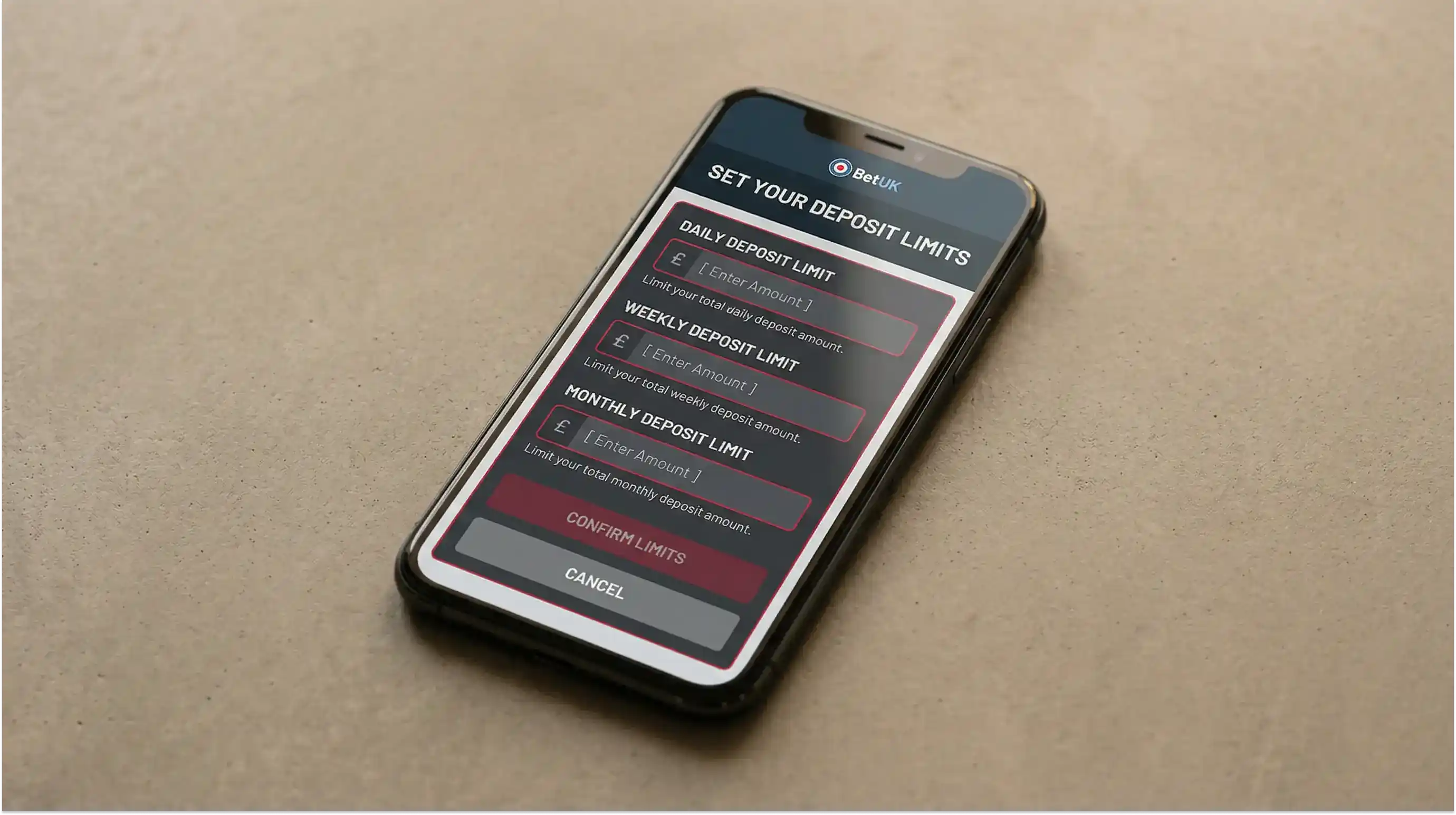
Configuring Mandatory Prompts for UK Deposit Limits
I opened a fresh sportsbook account on the morning of 1 November 2025 to see what the new prompt looked like in practice. Before I could deposit a pound, a full-screen dialogue appeared asking whether I wanted to set a daily, weekly or monthly deposit limit. Three input fields, a confirmation button, and a single line of text noting that I could skip the prompt if I preferred. Not a pop-up I could dismiss with a stray click. A genuine checkpoint.
That checkpoint is now mandatory across every UK Gambling Commission-licensed operator. From 31 October 2025, each operator has to prompt new customers to set a financial limit before their first deposit. The commission’s chief executive framed it when the rule was announced: “from the end of this month [31 October] our new rules will give consumer controls over deposit limits and all gambling businesses must prompt their customers to set a financial limit before they make their first deposit.” The prompt is soft-touch — you can skip it — but it has to be presented, clearly, before money moves.
The rule sits alongside a cluster of other 2025 changes that pushed UK betting toward more structural consumer protection. Light-touch financial vulnerability checks above £150 net monthly deposit. Slot-stake limits at £5 per spin for over-25s and £2 for 18-to-24-year-olds. The 1.1% statutory levy on online operators’ GGY funding research, prevention and treatment at a scale of £90 million to £100 million a year. The deposit-limit prompt is the piece of this bundle that most directly touches the weekly rhythm of a UK MMA bettor, and understanding how to use it well is the difference between a tool that quietly protects you and one that becomes a bureaucratic box to tick.
The Prompt: What It Shows, What It Costs to Skip
The prompt itself is simple by design. A dialogue appears after account registration and before your first deposit. It offers three input fields — daily, weekly and monthly — and a submit button. You enter values in any or all of the fields, or you skip. If you set a limit, the figure is applied immediately and carries the statutory cooling-off rules around changes, which I will come to. If you skip, your account sits without a deposit limit unless and until you set one manually from the account settings later.
Operators cannot pre-fill the fields with suggested values. That was a specific concession in the final version of the rule because pre-filled amounts anchored customers high. The fields are blank and the framing is neutral. What operators can do — and what all of them do — is follow the prompt with a second screen offering general advice on setting a responsible limit, typically linked to data from GambleAware or the Gambling Commission’s own research. Whether anyone reads it is a separate question.
Skipping the prompt does not mean no limit. It means no limit set by you. The operator’s own maximum deposit limits still apply — typically several thousand pounds per transaction and tens of thousands per month on most UK sportsbooks — and the light-touch vulnerability check kicks in automatically at £150 net monthly deposit. Skipping means you have actively declined to set a personal floor and you have chosen to rely on the operator’s ceiling and the regulator’s checkpoints instead. That is a legitimate choice but it is a choice.
The prompt is reinforced by secondary prompts later in the customer lifecycle. If your deposit activity changes materially, operators are required to prompt you again. If you breach a trigger — for instance, depositing close to the light-touch threshold repeatedly — the operator will run the vulnerability check and may introduce further prompts. These secondary checks exist because the initial decision is often made at the moment of highest impulse, which is not when a considered limit gets chosen. The commission’s figures suggest that roughly 2.7% of UK adults meet the problem-gambling threshold under PGSI scoring, and the prompt architecture is designed with the tail of that distribution in mind.
Daily, Weekly and Monthly Ceilings for MMA Bettors
The three-tier structure of daily, weekly and monthly limits is more useful for MMA bettors than it looks, because the rhythm of UFC and wider MMA betting falls into predictable cycles. Most UK bettors have one or two big cards per weekend, occasional Fight Night bouts during the week, and long gaps between PPV events. A well-set limit structure reflects that rhythm rather than fighting it.
A daily limit is your hard stop on a given card. It should reflect the stake you would be comfortable losing on the biggest card of a typical month — not the biggest card of the year, which would set the number too high. If a £100 afternoon on UFC London feels like a fair recreational ceiling, the daily should sit at £100 and not £200. The limit is not a target; it is a ceiling you do not need to reach.
A weekly limit catches the scenario where two cards fall in the same week — a Fight Night on Saturday and a PFL card on Friday, for instance — and prevents the daily limit being hit twice in rapid succession. Setting the weekly to between 1.5 and 2 times the daily keeps the structure coherent. Anything higher makes the weekly ceiling redundant; anything lower makes it conflict with the daily.
A monthly limit is the macro control. It reflects the total you can afford to commit to betting across an average month, accounting for cards that do not land in the UK calendar and for the variance that will hit your bankroll regardless of discipline. The monthly should sit at roughly four times the weekly, which creates a coherent nested structure: any single day is capped, any single week is capped, any month is capped, and the ceilings reinforce rather than contradict each other. For a recreational UK MMA bettor with a £100 daily, £200 weekly structure, a £400 monthly cap is roughly the right order of magnitude.
One variant I see frequently: bettors who set only a monthly limit and leave daily and weekly blank. The logic is that the monthly is the number that actually matters for bankroll. Fine in theory. In practice, the absence of a daily cap means a single bad afternoon can consume half the monthly allocation, leaving the remaining three weeks operating under a fraction of the original framework. Set all three. It costs nothing and the nesting protects you from the day you most need protecting from.
Raising or Lowering Your Limit: Cooling-Off Periods
The cooling-off architecture around limit changes is the single most important protective feature of the UK deposit-limit system, and it is the one most people do not know about until they try to change a limit for the first time.
Lowering a limit takes effect immediately. If you set your daily to £50 at registration and later decide to drop it to £25, the change applies within seconds and no cooling-off period gates it. The design logic is obvious: the regulator wants it to be frictionless to reduce exposure, and it would be perverse to introduce a delay when the customer is trying to become safer.
Raising a limit is gated by a mandatory cooling-off period. The specific duration varies slightly by operator but the UKGC’s LCCP guidance prescribes a minimum of 24 hours for increases, and most UK operators apply 48 to 72 hours as standard. Some apply seven days for larger increases above a threshold. The cooling-off period exists because a lot of limit-raise requests come during loss-chasing episodes — the moment when a bettor most needs structural friction — and the 24-to-72-hour window allows the urgency to pass before the change takes effect.
What the cooling-off period does not do is expire your original intent. If you request an increase and then change your mind during the cooling-off window, you can cancel the request and the limit stays where it is. Operators are required to provide an obvious cancellation route; most do so via a confirmation screen that appears once the cooling-off has elapsed, requiring you to re-confirm the increase before it applies. If you let that confirmation screen sit, nothing happens. The old limit persists.
Multiple accounts across multiple operators is where the architecture gets leaky. Each operator sets limits independently. A £100 daily at one sportsbook plus a £100 daily at another is a £200 effective daily across the two. The UKGC is aware of this and the GAMSTOP register covers self-exclusion across operators, but ordinary deposit limits remain per-operator. The practical answer is to treat your primary UK sportsbook as the account that sets your true limit and avoid spreading deposits across multiple books for the explicit purpose of circumventing a limit you set on yourself.
Deposit Limits vs Affordability Checks: Not the Same Thing
These two tools get confused constantly, and they work in completely different ways. Deposit limits are self-imposed caps you set and can change, subject to the cooling-off rules. Affordability checks are operator-imposed assessments triggered by your gambling activity crossing defined thresholds.
The light-touch financial vulnerability check applies to customers with net deposits above £150 per calendar month. “Net” means deposits minus withdrawals, so a bettor who deposits £500 and withdraws £400 in the same month is at £100 net and below the threshold. The check is automated where possible — it looks at publicly available financial data, credit-file indicators, and aggregate information about the customer — and does not require the bettor to submit payslips or bank statements at this stage. The commission built it deliberately lighter than the earlier, more invasive model floated in the 2023 White Paper consultations, precisely to avoid the friction that would push bettors to unlicensed operators. You may not even notice it running.
A heavier affordability check can be triggered at higher deposit levels or where patterns of concerning behaviour appear — rapid deposit-and-redeposit cycles, escalating stakes after losses, late-night activity spikes. At that point the operator may request source-of-funds documentation. This is where deposits get held, withdrawals get delayed, and the customer experience genuinely changes. For most recreational MMA bettors, the heavier check will never trigger. For a minority whose betting activity raises flags, it is the mechanism through which the regulatory system intervenes.
Deposit limits reduce the probability of triggering any affordability check in the first place. A bettor operating under self-imposed monthly caps that sit below £150 net never activates the light-touch check. A bettor operating under caps that sit below the heavier thresholds never triggers the harder check. Setting sensible limits is not just personal risk management; it is also the quietest way to stay outside the pattern of operator-initiated scrutiny.
Can I set different deposit limits across multiple UK MMA books?
Yes. Each UK-licensed operator applies deposit limits independently on their own account system. There is no cross-operator register that aggregates limits across sportsbooks the way GAMSTOP aggregates self-exclusion. If you hold accounts at three UK bookmakers, your effective total daily deposit ceiling is the sum of the individual limits — which is why operating from a single primary account is usually the cleaner structure.
Does skipping the UK deposit prompt mean no limit at all?
It means no limit set by you. The operator’s own per-transaction and per-period maximums still apply, and the light-touch financial vulnerability check activates at £150 net monthly deposit regardless of whether you set a personal limit. Skipping removes only the personal layer; the regulatory layers remain in place.
Published by the mma Betting Online team.