MMA Betting Glossary and Wagering Terms
 Available in US
Defining Local Terminology in the MMA Betting Glossary
A reader sent me a glossary screenshot from an American MMA betting site last year and asked me to annotate the terms that meant different things in the UK. Half of them turned out to need adjustments. “Parlay” becomes “accumulator” or “acca” on British books. “Vigorish” becomes “overround” or just “margin”. “Point spread” barely exists in MMA anywhere, but the British equivalents for fight-specific markets use different vocabulary entirely. A global MMA glossary is useful as far as it goes; a UK-specific one does the translation work the global version cannot.
This glossary covers the terms you will encounter on UK sportsbooks when betting on UFC, PFL, Cage Warriors, KSW and Oktagon, organised A through Z for reference use during a live card or while researching a bet. The terms cross-reference a number of deeper pieces across the project. The piece on UK MMA betting online is the master reference for how the entries fit together in practice; this glossary is the look-up index for the specific vocabulary.
A to F: From Acca to Fractional Odds
Acca is the British shortening of accumulator — a multi-leg bet where every leg must win for the slip to pay out. On a UK UFC card, a four-fight acca backing the favourite in each bout settles only if all four win. Any single loss voids the whole slip. Accumulator odds multiply the individual leg prices, which is why small-ticket accas can produce large prospective payouts.
Acca insurance is the promotional refund on accumulators that lose by exactly one leg. UK standard structure is a refund up to a capped amount in free-bet form if one and only one leg fails. The promotion requires minimum legs (usually four or five) at minimum odds per leg (usually 1.50 or higher).
Affordability check is the operator-initiated verification that a customer can afford their current deposit activity without financial harm. Light-touch checks trigger at £150 net monthly deposit under current UKGC LCCP rules; heavier checks apply at higher thresholds.
American odds is the pricing format using plus and minus numbers around a zero baseline. +150 means a £100 stake returns £150 profit; -150 means a £150 stake returns £100 profit. Less common on UK books but standard in US-originated MMA analytics.
Bet builder is the UK sportsbook product that combines multiple selections within a single fight into one composite bet. Legs might include fighter to win, method of victory, total rounds and fight to end inside distance — all within one UFC bout.
BGC is the Betting and Gaming Council, the UK industry trade body that coordinates Safer Gambling Week and represents member operators on regulatory and public-affairs matters. Not the same as the UKGC.
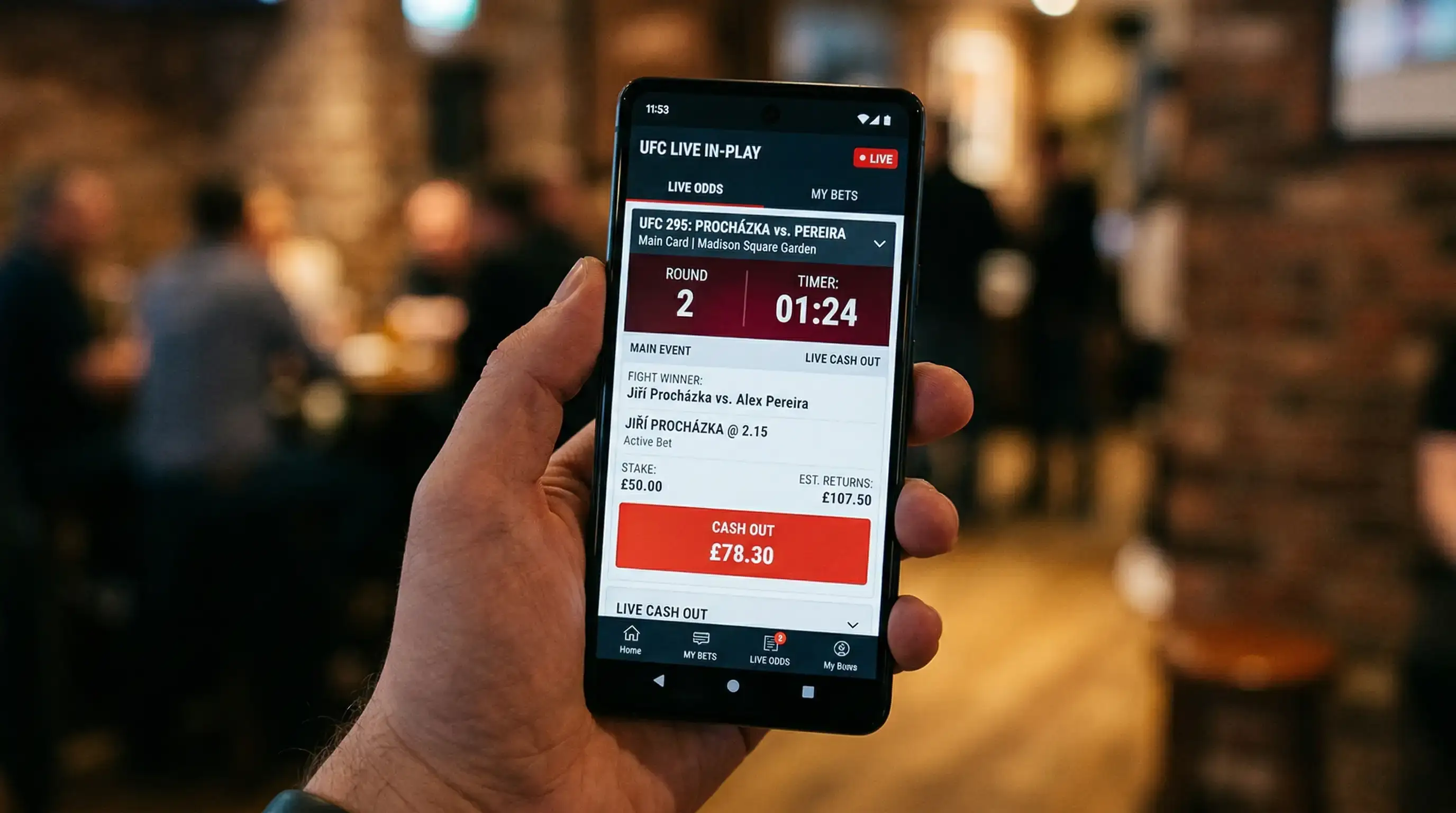
Cash-out is the in-play settlement option that lets you close a bet before the fight ends at a price calculated from current live odds. UK books typically skim a 5% to 15% margin on cash-out offers relative to fair value.
Closing line is the final price on a market before the fight starts or the market suspends. The closing line reflects all pre-event information and is the benchmark against which edge is measured.
Closing line value (CLV) is the percentage by which a bet’s taken price beats the closing price. Positive CLV signals analytical edge over long samples.
Decimal odds displays total return per unit staked. 2.25 means a £1 stake returns £2.25 total including stake. Cleaner arithmetic than fractional; standard on exchanges and European books.
Draw is the rare MMA result where the fight ends without a winner. Under 2% of MMA fights end in draws, which is why moneyline markets are usually two-way rather than three-way.
Fractional odds displays profit relative to stake. 5/4 means a £4 stake returns £5 profit. UK historical default; still the most commonly displayed format on British books.
G to M: From GGY to Moneyline
GAMSTOP is the UK self-exclusion register covering every UKGC-licensed operator. Free enrolment for 6 months, 1 year or 5 years. Blocks new-account creation and existing-account access across the entire UK-licensed industry.
Gambling Commission is the UK regulator for gambling operators. Everyone calls it the UKGC. Issues and enforces licences, maintains the public register, and supervises the Licence Conditions and Codes of Practice. Total industry GGY supervised reached £16.8 billion in the 2024/25 reporting year.
GambleAware is the UK charity funded primarily through the statutory gambling levy, delivering research, prevention and treatment services for gambling harm. Works alongside NHS specialist clinics on treatment pathways.
GGY is Gross Gambling Yield — the amount operators retain after paying out winnings but before costs and taxes. UK remote betting GGY hit £2.6 billion in 2024/25, with football at £1.3 billion and horse racing at £766.7 million as the two largest segments.
GSGB is the Gambling Survey for Great Britain, the UKGC’s flagship prevalence study. Placed the adult problem gambling rate at 2.7% in 2024 using PGSI 8+ classification.
HMRC is His Majesty’s Revenue and Customs, the UK tax authority. Relevant to gambling in that UK individuals do not pay personal tax on gambling winnings; operators pay duty on their gross profits.
Implied probability is the decimal odds reciprocal — 1 divided by the price. 2.50 decimal implies 40% probability. Essential calculation for comparing market pricing against analytical estimates of true outcome probabilities.
In-play betting is wagering placed after the fight has started. UK books offer in-play markets with live odds that adjust between rounds and during active rounds based on fight events and late arriving information.
KYC is Know Your Customer — identity and age verification required before a UK-licensed operator can accept bets. Must complete before first bet under LCCP rules.
LCCP is the Licence Conditions and Codes of Practice, the UKGC’s detailed rulebook that every licensed operator must follow. Covers age verification, complaint handling, player-funds protection, responsible-gambling tools and promotional terms.
Margin is the operator’s embedded profit percentage in market pricing. Also called overround or vig. UK UFC main-event moneyline margins run 4% to 6%; method markets run 10% to 15%.
Method of victory is the market covering how the fight ends — KO/TKO, submission or decision — for each fighter. One of the most widely-traded UFC props on UK books.
Moneyline is the market on which fighter wins, without consideration for method or duration. UFC favourites win roughly 72% of fights overall, which anchors the baseline for moneyline pricing.
N to S: From No Contest to Submission
No contest is the fight result when a bout is stopped under conditions that prevent a winner being declared — typically accidental fouls or injuries. Under 1% of MMA fights end in no contest. UK moneyline markets usually void both sides on a no-contest ruling, refunding stakes.
Open Banking is the regulated API-based bank transfer infrastructure that UK operators increasingly offer as a deposit method. Instant processing, clean audit trail, no card or e-wallet intermediary.
Overround is the British term for the operator’s embedded margin, calculated as the sum of the implied probabilities of all outcomes minus 100%. A two-way market where the implied probabilities add to 104% has a 4% overround. Also called margin or vig.
Over/under is the market on total rounds or fight duration. “Over 2.5 rounds” settles yes if the fight continues past the halfway mark of round three. Weight-class finish rates shape the pricing of these lines materially.
Parlay is the American term for accumulator. Rare in UK sportsbook usage but appears in US-originated MMA analytics content.
Paysafecard is the prepaid voucher deposit method used on UK sportsbooks. One-way funding only — winnings withdraw through a different method. Useful for session-controlled deposit budgets.
PGSI is the Problem Gambling Severity Index, the nine-item scale used in UK gambling-prevalence surveys to classify gambling risk. Scores of 8+ indicate problem gambling; 3 to 7 is moderate risk; 1 to 2 is low risk.
Point spread does not apply to MMA. UK markets use round lines and over/under totals instead.
Price boost is a promotional shortening of the operator’s margin on a specific market for customer acquisition purposes. Boosted bet builders often represent genuine value compared to their unboosted equivalents.
Props or prop markets are the specific side-bets beyond moneyline, method and totals — which round a fight ends in, whether a specific fighter is knocked down, specific combination outcomes. Margins are typically wider than core markets.
Responsible gambling is the umbrella term for consumer-protection tools and framing across UK gambling. Deposit limits, self-exclusion, session timers, realistic-messaging campaigns all fall under the heading.
Round betting is the specific-round market identifying which round the fight ends in. Prices vary substantially by weight class because heavyweight fights end earlier than lightweight fights on average.
Self-exclusion is the mechanism for blocking your own gambling account access. GAMSTOP operates this centrally across all UK-licensed operators. Durations range from 6 months to 5 years.
Single bet is the simplest UK sportsbook wager: one selection, one outcome, one fight. The baseline structure against which all multi-leg and combined products get measured.
Skrill is the e-wallet specialised for gambling use cases with wide UK operator coverage. Faster processing than PayPal for many gambling transactions, small fees on some operations.
Stake is the amount of money you put on a bet. Different from total return, which includes the stake plus profit. Fractional odds show profit against stake; decimal odds show total return including stake.
Submission is one of the two finish methods in MMA, alongside knockout/TKO. A fighter submits by tapping, verbally conceding, or being rendered unable to continue from a choke. UK method-of-victory markets separate submission from KO/TKO as distinct outcomes.
T to Z: From Take-Back to Vig
Take-back is operator slang for the portion of wagers the house retains on a specific market — the inverse framing of overround.
Tapology is an MMA fight-database service used by analysts and operators for fighter history and statistical research.
TKO is the result where a fighter wins by the referee stopping the fight due to damage or inability to continue, without one fighter being unconscious. Grouped with KO as one of the two finishing methods distinct from submission and decision.
TKO Group Holdings is UFC’s parent company, reporting $1.502 billion in UFC revenue for 2025 with a 57% adjusted EBITDA margin. The corporate entity whose earnings filings shape the commercial context for UK MMA betting markets.
TNT Sports is the exclusive UK and Ireland UFC broadcaster. Distributes Fight Nights on core channels and PPV cards via TNT Sports Box Office and HBO Max.
UKGC is the UK Gambling Commission. See Gambling Commission entry.
Underdog is the fighter priced longer than evens (2.00 decimal or 1/1 fractional) on the moneyline market. UFC underdogs win roughly 28% to 30% of fights overall, with higher rates on co-main events (40%) than main events (23%).
Upset is the result where the underdog wins. Upset rates vary by card position — 23% for main events, 40% for co-mains, roughly 30% across all clear-favourite fights.
Vig is short for vigorish, the American term for bookmaker margin. UK books usually call it overround or margin; vig appears in US-originated MMA analytics and occasionally bleeds into UK conversation.
Void is the bet status when a market is cancelled — typically due to a fight cancellation, a no-contest result, or a disqualification under specific operator rules. Stakes are returned without profit or loss. UFC fight cards generate a non-trivial number of void settlements each year due to late fighter withdrawals.
Wagering requirement is the multiplier of bonus funds that must be staked before the bonus becomes withdrawable. More common in casino than sportsbook under UK terms, but welcome bonuses on UK UFC sites typically carry qualifying-bet conditions that function as wagering requirements by another name.
Weigh-in is the pre-fight weight verification event, usually Friday evening before a Saturday card. Any fighter missing weight triggers possible void rulings on associated prop markets.
Yield is the operator’s gross revenue from a market or time period. GGY — gross gambling yield — is the industry-wide measurement used in UKGC reporting.
What is the difference between a push and a void on a UK MMA slip?
A push is a tied result where the selection neither wins nor loses — rare in MMA because moneylines are usually two-way and do not accommodate ties. A void is a cancelled bet, typically from a fight cancellation, no-contest result, or specific rule trigger that cancels the market entirely. Both return the stake, but the causes and contexts are different. UK MMA sites use void more often than push because the structural conditions for pushes are uncommon in combat sports.
Is ‘vig’ the same thing UK books call ‘overround’?
Yes, with a subtle framing difference. Vig is American terminology for the bookmaker’s embedded margin; overround is the British mathematical expression of the same thing, calculated as the sum of implied probabilities minus 100%. On UK books the 4% to 6% main-event margin gets called overround in official documentation and vig in casual conversation. Both terms refer to the same underlying operator profit per market.
Prepared by the mma Betting Online editorial staff.