UFC Odds Conversion and Implied Probability Formulas
 Available in US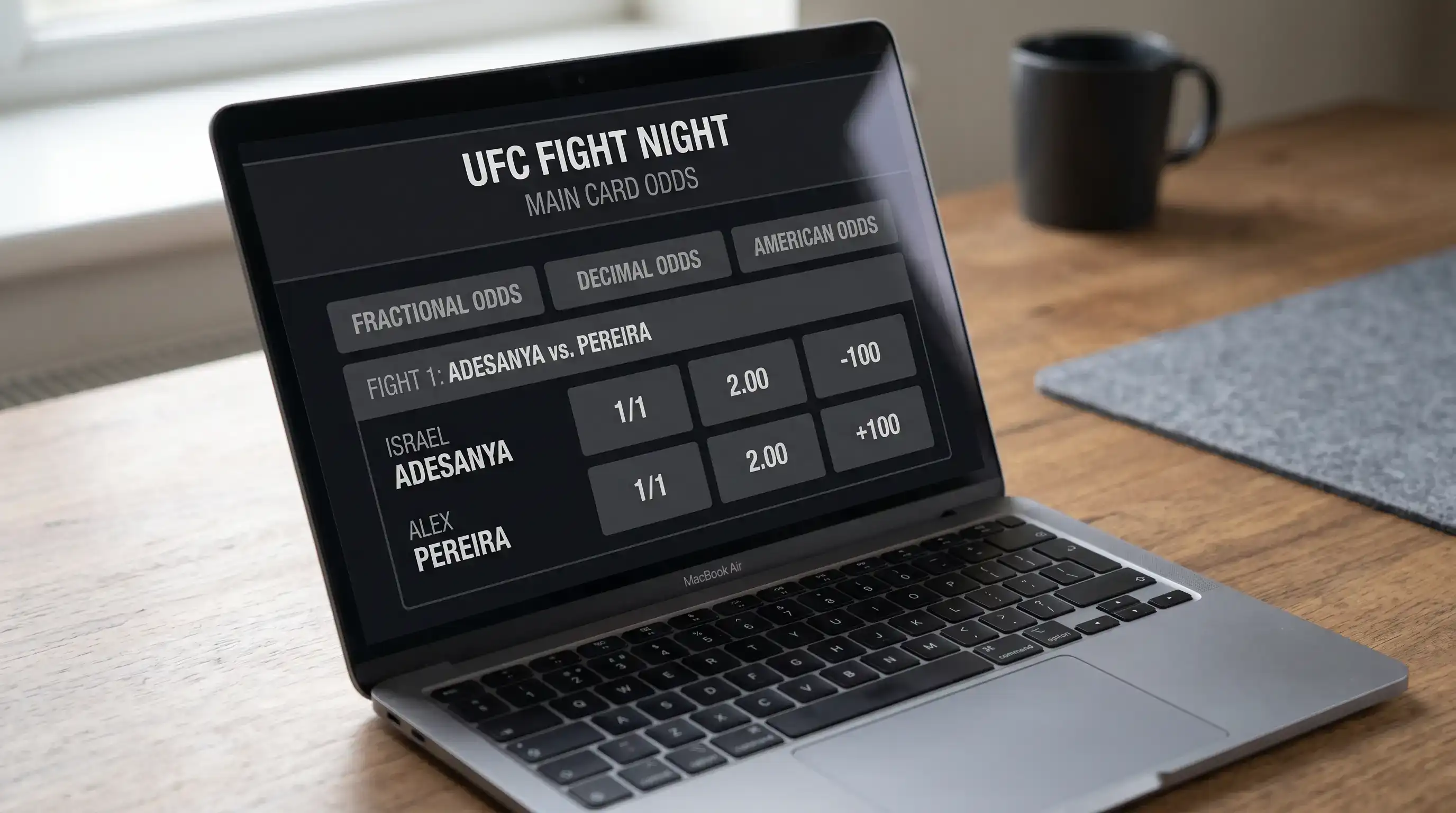
Calculating Implied Probabilities During UFC Odds Conversion
A friend new to UFC betting asked me last year why a fighter was priced 5/4 on one app, 2.25 on another and +125 on a third. He thought the prices were different. They were identical — three display conventions for the same underlying probability. Once you see the equivalence, the entire odds landscape simplifies, and you can compare UK sportsbooks, exchanges and overseas books without getting fooled by notation.
Fractional, decimal and American odds are three ways of writing the same mathematical object: the ratio of payout to stake. UK sportsbooks default to fractional because that is the British historical convention. European and Asian books default to decimal because the arithmetic is cleaner. American books default to American odds because, well, they are American. Every serious UK MMA bettor needs to move between the three fluently, because odds comparisons, CLV tracking and exchange liquidity analysis require the shared language.
This piece works through all three formats, provides the conversion rules, and ends with a printable reference table for the UFC price points you will encounter most often on UK books. Readers who want the broader market-pricing context should see the piece on UFC odds and value betting for UK punters; this is the mechanical odds-literacy foundation that everything else builds on.
Fractional Format: The UK Default
Fractional odds display the ratio of profit to stake. 5/4 means a £4 stake returns £5 of profit plus your original stake, so your total return is £9 on a £4 bet. The number before the slash is your profit; the number after is what you must stake to earn it.
The logic is intuitive once you see it, but it obscures implied probability in ways that matter for betting decisions. Most UK punters look at 5/4 and know it is “better than evens” without thinking much about exactly what win probability the price implies. Evens — 1/1 — implies a 50% break-even probability. 5/4 implies 44.44%. 2/1 implies 33.33%. The calculation is always the denominator divided by the sum of numerator and denominator, but doing that arithmetic in your head on common UK fractions is slower than the decimal equivalent.
Fractional also gets awkward on short prices. A heavy UFC favourite might be 1/4 — stake £4 to win £1, £5 total return. It is correct notation but unintuitive because the profit is smaller than the stake. Shorter favourites can go to 1/8, 1/12, 1/20, which look ugly on the page. UK books display these alongside a “show as decimal” option precisely because the fractional form is mentally awkward at these price levels.
Long odds have their own complications. 7/2 is 3.5 times your stake in profit plus the stake back. 9/4 is 2.25 times. 11/4 is 2.75 times. The half-steps in fractional notation — 9/2, 11/2, 13/2 — are historical conventions that do not map cleanly onto mental arithmetic for most bettors. Decimal is faster at these price points, which is why sharp UK bettors switch their account display to decimal on exchanges even when placing bets on fractional-native sportsbooks.
One practical note. UK books round fractional prices to the nearest “standard” fraction from the convention list. 1.86 decimal gets rounded to 5/6, not left as 0.86/1, because the standard list does not include that fraction. The rounding usually favours the book by a fractional percentage point. Exchange prices, which trade in decimal natively, sit closer to true mid-market prices because they are not constrained to the fractional notation’s limited step sizes.
Decimal Format: Exchange and Euro Books
Decimal odds display total return per unit staked. 2.25 means a £1 stake returns £2.25 total — £1.25 of profit plus the £1 stake. The mathematics is cleaner because there is one number doing one job, and the implied probability calculation is simply 1 divided by the decimal price. 2.25 implies 1/2.25 = 44.44% probability, the same number we got from 5/4 fractional above.
Decimal is the default on Betfair and most UK-accessible exchanges, on European sportsbooks serving UK customers, and on almost every UFC analytics platform. The format choice is not random; professional sports-betting operations and data aggregators almost universally use decimal because comparisons, CLV calculations and margin analysis all become one-step arithmetic rather than two-step conversions.
The clean arithmetic has specific advantages in MMA. Comparing prices across two UK sportsbooks is trivial in decimal — 2.25 is better than 2.20, full stop. Comparing the same prices in fractional requires either conversion or experience with which specific fractions are larger than which. 9/4 is larger than 6/5 is larger than 11/10, but telling a newer bettor that without converting to decimal requires familiarity most UK punters do not have in their first year.
Decimal margin calculation is also cleaner. Add the reciprocals of both sides of a two-way market — 1/price A plus 1/price B — and you get the total implied probability. If it exceeds 100%, the difference above 100% is the operator’s margin expressed as a percentage. On a fight priced 1.50 and 2.50, the reciprocals are 0.667 and 0.400; sum is 1.067; margin is 6.7%. Trying to do that calculation from fractional prices requires an extra conversion step that slows down real-time market comparison.
One regional note. Asian handicap markets and Asian-facing books use decimal as standard, which matters for UK bettors who use global exchanges where Asian liquidity pools contribute to the pricing. The exchange closing price on a UFC main event often reflects combined UK-retail and Asian-professional money, and the decimal display is the shared language across those pools. UK sportsbooks that offer “decimal view” toggles are not just accommodating European expats; they are providing the format that sharp pricing comparison actually requires.
American Format: Why UK Punters See It Anyway
American odds split into positive and negative numbers depending on whether the fighter is a favourite or underdog. +150 means £150 profit on a £100 stake. -150 means £100 profit on a £150 stake. The breakeven point is always zero — favourites are negative, underdogs are positive, with the magnitude reflecting how strong the price is on either side.
You will see American odds on US-based MMA analytics sites like MMAOddsBreaker, on international exchange liquidity pools, and in cross-market comparisons published by aggregators. The format is rarely used directly on UK sportsbooks, but UK bettors running analytical comparisons across global sources need to be able to convert fluently in both directions.
The conversion from American to decimal is slightly fiddly because the formula differs depending on whether the price is positive or negative. For positive American prices, decimal = (American/100) + 1. So +150 converts to 1.50 + 1 = 2.50 decimal. For negative American prices, decimal = (100/|American|) + 1. So -150 converts to (100/150) + 1 = 0.667 + 1 = 1.667 decimal, rounded to 1.67.
In the opposite direction, converting decimal to American: for decimal prices above 2.0, American = (decimal – 1) × 100. So 2.50 decimal becomes (1.50) × 100 = +150 American. For decimal prices below 2.0, American = -100 / (decimal – 1). So 1.67 decimal becomes -100 / 0.67 = -149 American, rounded to -150. Evens (2.00 decimal) converts to +100 American exactly.
The reason I cover American format at length is that the UFC’s home market is the United States, and much of the sharpest MMA analytical work is published in American pricing. UK bettors who only read their own sportsbook’s fractional display miss access to analytics that would improve their own pricing models. Fluency in all three formats is not an affectation; it is a prerequisite for operating at the level where closing-line value and underdog mispricing identification actually work.
The Three Conversion Rules You Need
The three rules cover every format conversion a UK MMA bettor will ever need. Memorising them takes ten minutes; applying them fluently takes a few weeks of practice.
Rule one: fractional to decimal. Add 1 to the fractional value. 5/4 = 1.25, plus 1 = 2.25 decimal. 9/4 = 2.25, plus 1 = 3.25 decimal. 1/4 = 0.25, plus 1 = 1.25 decimal. The logic is that decimal includes your original stake in the return figure while fractional shows only the profit.
Rule two: decimal to fractional. Subtract 1 from the decimal value to get the profit ratio, then express as a fraction. 2.25 decimal minus 1 = 1.25 profit ratio, which equals 5/4 fractional. 3.50 decimal minus 1 = 2.50 profit ratio, which equals 5/2 or 2.5/1 fractional (UK books standardise to 5/2). 1.67 decimal minus 1 = 0.67 profit ratio, which equals 2/3 fractional. The last one shows why UK books occasionally display half-steps — 0.67 is not cleanly expressible as a standard fraction, so the book rounds to 2/3 with a small approximation.
Rule three: decimal to implied probability. Take the reciprocal — 1 divided by the decimal price. 2.00 decimal = 1/2 = 50% implied probability. 2.50 decimal = 1/2.5 = 40%. 1.50 decimal = 1/1.5 = 66.67%. This is the single most useful calculation in all of sports betting because it lets you compare the market’s implied win probability against your own analytical estimate directly, which is the foundation of every value-betting framework I have ever seen work.
Between these three rules you can move between any pair of formats. Fractional-to-American works by going via decimal: convert the fractional to decimal first, then apply the American conversion rule. Same for American-to-fractional. The arithmetic takes two steps but is mechanical once you have the building blocks.
A Reference Table of Common UFC Odds
The UFC price points that recur most often on UK sportsbooks cluster in a predictable band around main-event favourites (1.30 to 1.80 decimal), co-main and undercard favourites (1.50 to 2.00 decimal), close matchups (1.80 to 2.50 decimal) and underdogs (2.20 to 5.00 decimal). The table below covers the key conversion equivalents for this range.
Fractional 1/5 = decimal 1.20 = American -500, implied probability 83.3%. Fractional 1/3 = decimal 1.33 = American -303, implied probability 75.2%. Fractional 2/5 = decimal 1.40 = American -250, implied probability 71.4%. Fractional 1/2 = decimal 1.50 = American -200, implied probability 66.7%. Fractional 4/6 = decimal 1.67 = American -150, implied probability 60%. Fractional 4/5 = decimal 1.80 = American -125, implied probability 55.6%. Fractional evens (1/1) = decimal 2.00 = American +100, implied probability 50%.
Fractional 6/5 = decimal 2.20 = American +120, implied probability 45.5%. Fractional 5/4 = decimal 2.25 = American +125, implied probability 44.4%. Fractional 11/8 = decimal 2.38 = American +138, implied probability 42.1%. Fractional 6/4 (3/2) = decimal 2.50 = American +150, implied probability 40%. Fractional 7/4 = decimal 2.75 = American +175, implied probability 36.4%. Fractional 2/1 = decimal 3.00 = American +200, implied probability 33.3%. Fractional 5/2 = decimal 3.50 = American +250, implied probability 28.6%. Fractional 3/1 = decimal 4.00 = American +300, implied probability 25%.
One observation that connects back to broader UFC betting analytics. UFC favourites overall win roughly 72% of fights, which corresponds to a decimal price of 1.39 or fractional 2/5. That is the baseline implied probability for a “typical” UFC favourite. Any favourite priced shorter than 1.39 is being priced by the market as stronger-than-average; any favourite priced longer than 1.39 is weaker-than-average in the book’s view. Using the conversion table alongside that baseline produces quick market-efficiency intuitions: a 1.50 favourite is being priced at 66.7% probability against a divisional average of 72%, which either means the market sees this specific fighter as below-average or has mispriced the fight. The conversion literacy is what turns odds into actionable analysis.
Which odds format shows implied probability most intuitively for UFC?
Decimal format is the most intuitive for implied-probability calculation because the reciprocal of the decimal price is the implied probability directly. 2.00 decimal reciprocals to 50%; 2.50 reciprocals to 40%. Fractional requires adding 1 and taking a reciprocal; American requires conditional logic depending on sign. For real-time probability reasoning in UFC markets, decimal is the cleanest language and the one sharp bettors almost universally adopt.
Why does my UK book switch between fractional and decimal mid-session?
Most UK sportsbooks let users toggle display preferences in account settings, and some display decimals automatically for prices outside the standard fractional list or for in-play markets where updates happen faster than fractional notation can accommodate. The underlying price does not change — the display format does. If you see a price change between 1.86 and 5/6 on the same bet, the app has shifted displays rather than the book changing the line.
Written by the editors at mma Betting Online.