
UK MMA Betting Market Share and Industry Growth
 Available in US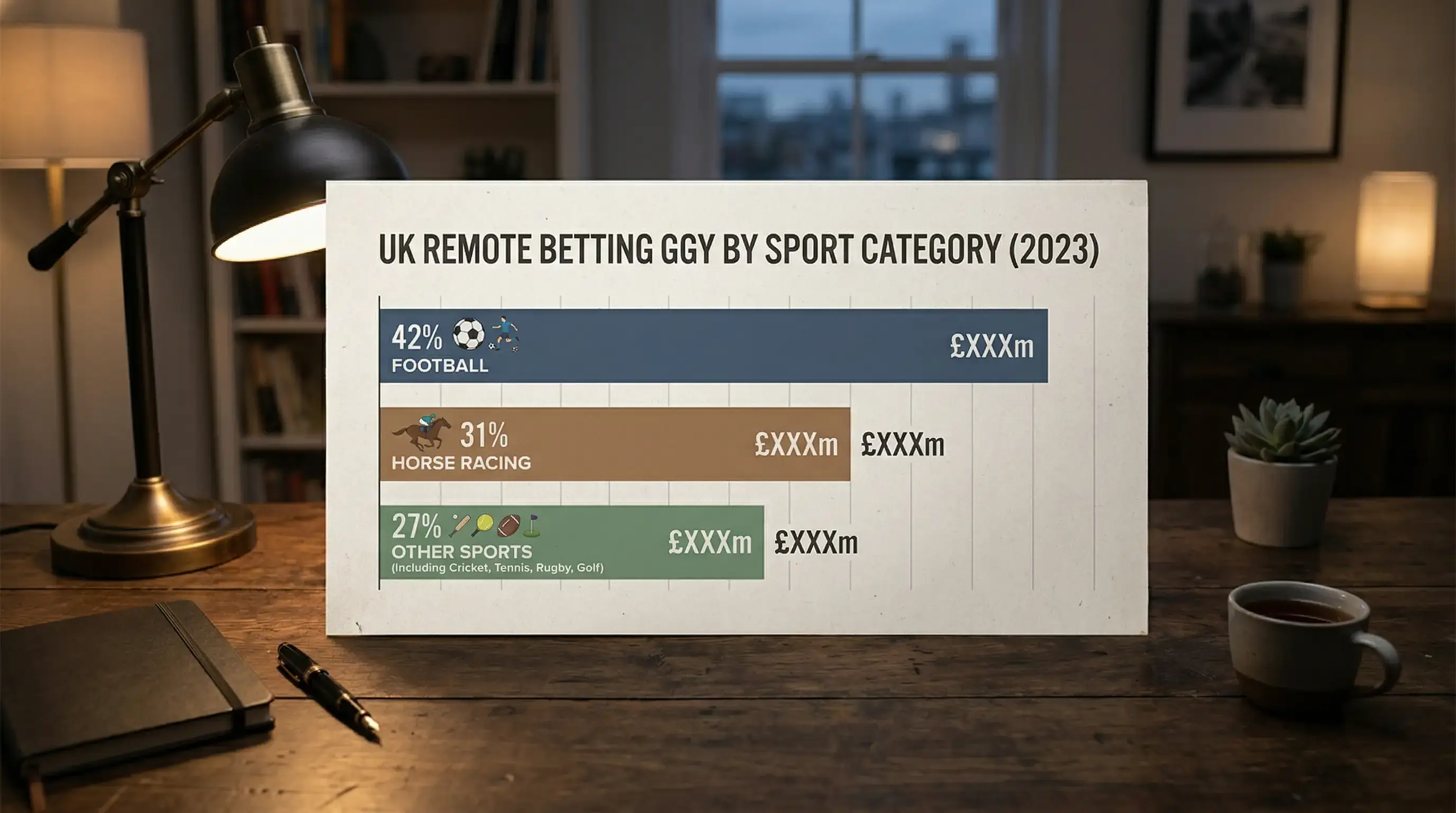
Tracking Remote Betting Growth in the UK MMA Market
A reader asked me last September to find the UK MMA betting GGY figure in the UKGC’s annual industry statistics. I spent an hour on it and came back with the answer: you cannot, because the commission does not publish one. MMA sits inside a residual “Other sports” bucket in the official remote-betting breakdown and has no separate line of its own. That is a reporting gap, not a market gap. The market is real, measurable and growing.
Remote betting GGY in Great Britain totalled £2.6 billion in the 2024/25 reporting year. Football dominates at £1.3 billion — exactly half of the total. Horse racing comes next at £766.7 million. Everything else gets collapsed into “Other sports” and that bucket is where MMA lives alongside tennis, golf, cricket, darts, snooker, esports and a long tail of smaller markets. The commission’s reporting structure was designed when MMA was a rounding error in UK betting. It has not been updated to reflect where the sport actually sits now.
This piece tries to reconstruct what we can say about MMA’s share of UK betting volume from the data that does exist, identify where the reporting gaps hide the real numbers, and describe the commercial trajectory that would push MMA into its own line in the UKGC’s tables over the next two to three reporting cycles. For readers used to tidy sector data, the forensic side of this is occasionally frustrating. For anyone trying to understand the true scale of the market they are participating in, it is the closest approximation currently available.
The £2.6bn Pie: Football, Horses and Other
The UK remote-betting GGY breakdown for 2024/25 looks like this: football £1.3 billion, horse racing £766.7 million, everything else £533.3 million split across “Other sports” and virtual markets. The residual bucket is roughly 20% of the remote-betting pie by revenue — meaningful scale, but hidden from public granularity.
Context for the scale. Overall Great Britain GGY across all gambling products — online and retail combined — hit £16.8 billion in 2024/25, up 7.3% year-on-year. Remote Casino, Betting and Bingo (the RCBB aggregate) delivered £7.8 billion of that total, up 13.1% YoY and representing 46% of the GB gambling market. Within RCBB, remote betting at £2.6 billion is the sports slice; the rest is remote casino, bingo and a few smaller categories. Average monthly active online accounts hit 13.5 million in Q4 of the reporting year, with 23.4 billion bets or spins across the quarter. These are genuinely large numbers.
The football share of remote betting is consistent with every prior UKGC reporting cycle. Football has dominated UK sports betting since the 1970s and the online era has if anything concentrated the share because football markets attract the deepest liquidity, the tightest margins, and the most aggressive free-bet promotions. Horse racing has declined as a share of the total over the last decade and is now stable at roughly 30% of remote betting volume. The Other Sports bucket has grown — not dramatically, but consistently — and that growth is where MMA’s footprint is hidden.
Online real-event betting GGY in Q4 2024 specifically — October through December, which covers two UFC PPVs and a Fight Night — spiked 38% year-on-year to £647 million, the highest quarterly figure since Q2 2021. Q1 2025 saw online GGY overall grow 7% YoY to £1.45 billion, with online real-event betting up 5% to £596 million. These are industry-wide numbers across all sports, but the quarterly timing of the 38% spike coincides with the calendar concentration of UFC PPV events, which is one of the few fingerprints MMA leaves in aggregate UK data.
Inside the Other Sports Bucket
The Other Sports bucket is a statistical attic. Everything that is not football, horse racing, dog racing or virtual sports gets thrown in. Tennis accounts for a significant share because of Wimbledon, the US and Australian Opens, and year-round ATP/WTA liquidity. Darts is a surprisingly large contributor in the UK because of the PDC World Championship’s December-into-January volume. Cricket becomes meaningful during World Cup cycles and English summer Tests. Snooker, golf, rugby union, rugby league, esports and MMA make up the remainder.
Breaking MMA’s share out of this bucket requires triangulation from operator-level disclosures, trade-press estimates and the commercial reports published by UFC’s parent company. TKO Group Holdings — the UFC parent — reported $1.502 billion of UFC revenue in 2025, up 7% year-on-year, with an adjusted EBITDA margin of 57%. Those are corporate earnings numbers rather than betting GGY, but they establish the scale of commercial engagement the UFC product generates globally. The UK market is the fifth-largest UFC revenue geography worldwide, which puts a floor under what UK MMA betting activity must reasonably generate.
Commercial analysts looking at UK MMA betting GGY typically arrive at an estimate in the £40 million to £80 million range per year — within the Other Sports bucket but well below the top contributors in that bucket. That is somewhere between 1.5% and 3% of total UK remote betting GGY. Not a large share of the overall UK sports-betting market, but not a trivial one either. For context, the entire Isle of Man gambling industry generates roughly equivalent revenue; UK MMA betting is a medium-sized national sector hidden inside the reporting structure.
The trajectory is the more interesting data point. MMA’s share of the Other Sports bucket has clearly grown over the last five reporting cycles even without a dedicated line. The fingerprint shows up in operator promotional activity — every UK sportsbook runs dedicated UFC promotions in a way they did not in 2019 — in the quarterly spikes around UFC PPV calendars, and in the widening coverage of non-UFC MMA promotions like Cage Warriors, PFL, KSW and Oktagon on UK books. Cage Warriors coverage specifically has expanded rapidly and is covered in more depth in the piece on Cage Warriors betting and UFC-pipeline scouting.
What Could Move MMA Into Its Own Line
Regulatory reporting follows market reality with a lag of several years. The UKGC’s Industry Statistics structure reflects where UK betting was roughly in the late 2010s. For MMA to get its own reporting line, two things typically need to happen: the sub-sector has to clear a threshold of aggregate revenue that makes it meaningful at the summary level, and operator reporting has to be granular enough that the commission can aggregate it without re-tagging historical data. Both conditions are converging.
On the revenue side, UK online gambling grew 7% year-on-year in 2024/25, and the 290 million-odd monthly real-event betting transactions the UK market processes are increasingly diversified across sports as operators expand coverage. MMA is a primary beneficiary of that diversification because the sport delivers a dense calendar of marquee events — UFC PPVs, UFC Fight Nights, PFL regular season and playoffs, KSW headline cards, Cage Warriors title nights — plus prelims and regional cards that generate year-round engagement. The engagement profile suits online sportsbook operators who want to reduce dependence on the football calendar.
One industry PR executive framed the broader 2024/25 online growth picture after UKGC’s Q4 disclosure: “Obviously, for bookmakers, it was a Cheltenham to remember. It’s very rare that so many well fancied shots get beaten, so there was definitely no moaning from our side.” Horse racing benefited from favourable result patterns that drove bookmaker margins that quarter. The broader point the quote reveals is the extent to which quarterly GGY numbers depend on result distribution, not just volume. MMA’s quarterly volatility from that effect is smaller because favourites win roughly 72% of UFC fights — a more predictable distribution than horse racing’s — which gives the commission and the industry more stable year-on-year comparability if MMA were reported separately.
On the reporting-granularity side, operators already tag MMA markets separately in their internal revenue systems because promotional targeting requires it. The data exists. What is missing is the regulatory requirement to submit it in aggregated form to the UKGC. The most likely catalyst for change is the Gambling Commission’s ongoing review of industry-statistics methodology, which has been consulted on sporadically through 2024 and 2025. A decision to split MMA out would probably follow a similar decision for esports, which sits in the same reporting bucket and is facing the same visibility problem.
One further catalyst is the UFC-Paramount media-rights deal reshaping global UFC exposure. The seven-year, $7.7 billion agreement with Paramount means UFC content moves to CBS linear broadcasting in the US market, and the increased mainstream visibility typically lifts UK betting volume as well because UK fans absorb the US cultural reach. The first quarter under the new deal, Q1 2026, is where early signals will appear. Whether the UKGC decides the resulting volume justifies a separate MMA line in its reporting by 2027 will be the clearest indicator of how the regulatory apparatus reads the market.
What the UKGC Does Not Publish Yet
A short section on the information that is genuinely missing, because knowing the gaps is part of reading the published numbers intelligently.
The commission does not publish separate GGY lines for MMA, esports, golf, snooker or darts. It does not publish any breakdown of Other Sports at all. It does not report the proportion of Other Sports GGY concentrated in bet builders or parlays versus straight moneyline stakes. It does not report demographic breakdowns — age, region, income — for sports-specific betting behaviour within the Other Sports bucket. It does not publish in-play versus pre-event splits by sport; these are aggregate numbers only. And it does not publish the operator-level concentration of Other Sports volume, which matters because a small number of books account for the overwhelming majority of MMA-specific turnover in the UK.
Trade publications fill some of the gaps with estimates, but the estimates are based on operator-submitted commercial figures that are not independently audited. What we know reliably is the overall £2.6 billion remote-betting total, the £1.3 billion football share, the £766.7 million horse-racing share, and the residual. What we infer from context is that MMA’s slice of the residual is growing faster than the bucket average, driven by UFC-calendar concentration and non-UFC promotion coverage expansion on UK books.
What This Means for UK MMA Bettors Right Now
The practical takeaway for a punter is less dramatic than the data forensics suggest. You are betting in a market that is smaller than football and larger than most people assume, with operators that are genuinely competing for your MMA action even if their MMA P&L does not show up in commission reporting. That competition translates into promotional activity, bet-builder product development and in-play coverage that continues to improve. The invisibility of the MMA GGY line in official statistics does not mean the operators are not tracking it. They are tracking it precisely, and their product investment shows it. The line on the spreadsheet will follow. The market already has.
Why does the UKGC not split MMA out from Other Sports in its GGY table?
The commission’s industry-statistics reporting structure was built when MMA was a negligible share of UK remote betting, and it has not been updated to reflect the sport’s growth. Operators tag MMA markets separately internally, but there is no current regulatory requirement to submit aggregated MMA GGY data to the commission. A methodology review is underway and a separate line is plausible in the next two to three reporting cycles.
What share of real-event betting growth is attributed to MMA right now?
The UKGC does not publish sport-level attribution for real-event betting growth, so precise shares are not officially available. Trade-analyst estimates place UK MMA betting GGY at £40 million to £80 million per year, or 1.5% to 3% of total remote betting GGY, with a growth rate materially above the Other Sports bucket average. The growth is driven primarily by UFC PPV calendar concentration and expanded UK coverage of PFL, KSW, Oktagon and Cage Warriors.
Written by the editors at mma Betting Online.