UK Online Gambling Growth and MMA Betting Trends
 Available in US
Analyzing Market Dynamics from UK Online Gambling Growth
I walked past three closed betting shops on my high street last month. Two had been Ladbrokes, one had been Coral. The windows were papered over, the signage stripped, and the spaces were already being repurposed for other uses. Meanwhile, the UK online gambling sector is growing at 7% per year and currently tracks 13.5 million monthly active online accounts. The physical shops are closing; the digital market is expanding. That pattern shapes every aspect of what MMA betting on UK sites looks like in 2026.
The headline numbers from the UK Gambling Commission’s most recent reporting tell a clear story. Overall UK online GGY grew 7% year on year in the first quarter of 2025, hitting £1.45 billion. Online real-event betting — the category that includes UFC and all MMA markets — rose 5% to £596 million in the same quarter. Retail betting continued its long-term decline, with the total number of UK betting shops falling to 5,825 by March 2025, the eleventh consecutive quarter of retail contraction. The market is migrating online at a steady, measurable pace, and the migration has direct consequences for how MMA betting actually functions for British fans.
This piece unpacks the UKGC’s 2025 data, why the retail-to-online shift matters structurally, what 13.5 million active accounts actually means for competition and pricing, and what the specific implications are for UK MMA markets. The broader market-mapping sits in the companion piece on where MMA sits inside the £2.6bn UK remote betting market; this piece is the growth-trajectory picture that contextualises the MMA slice.
Headline Numbers from UKGC Q1 2025
The specific numbers worth memorising for anyone who wants to understand the UK betting landscape. Remote Casino, Betting and Bingo — the aggregated online gambling category — generated £7.8 billion of gross gambling yield in 2024/25, up 13.1% year on year. That represents 46% of total UK gambling GGY, which itself hit £16.8 billion across all channels with 7.3% year-on-year growth. The online component is the growth engine of the overall UK gambling market.
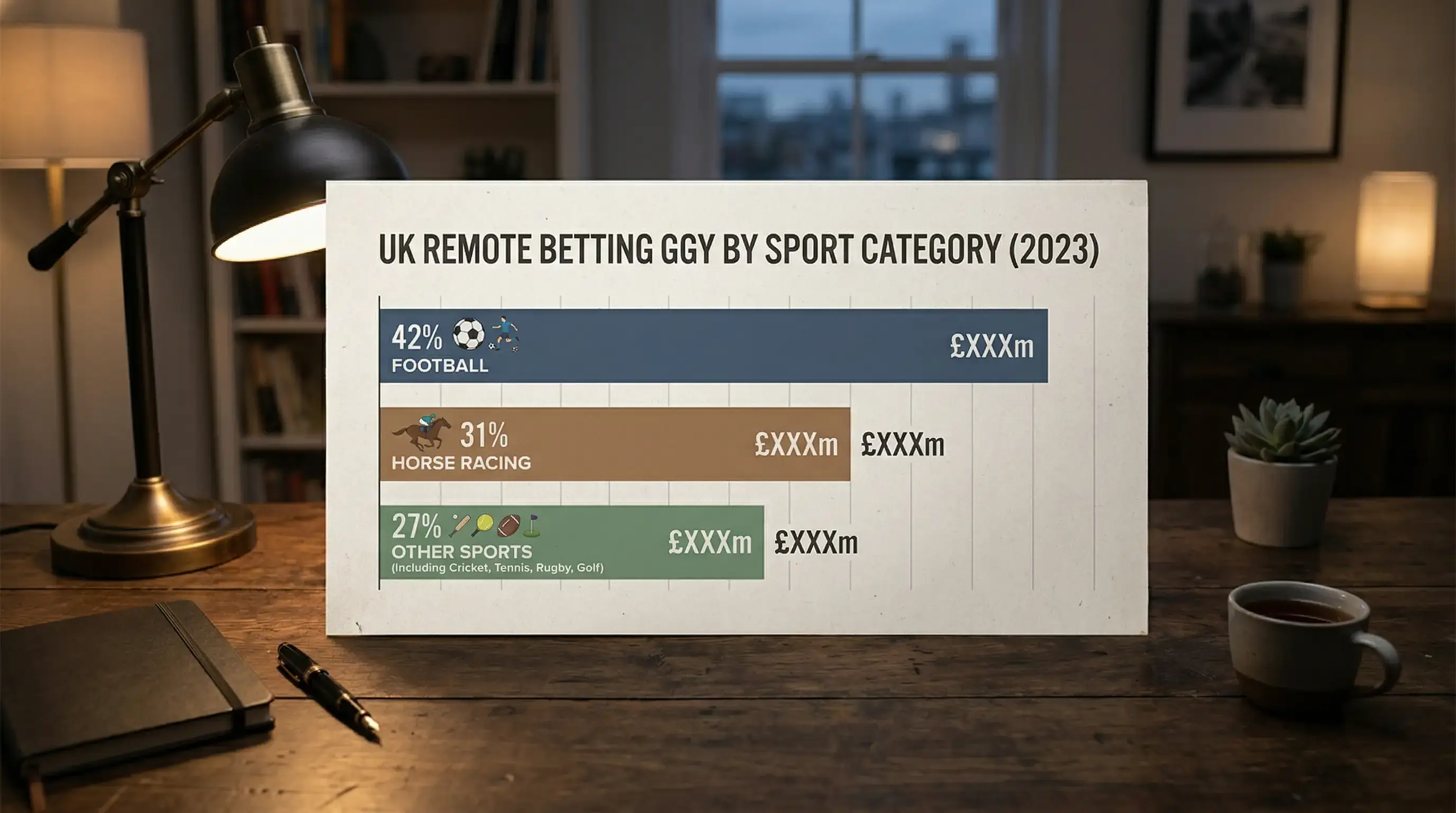
Within online, remote betting (sports wagering) produced £2.6 billion of GGY. Football dominated at £1.3 billion. Horse racing followed at £766.7 million. The remainder, including MMA, cricket, tennis, golf and other sports, added up to roughly £533 million in the residual category. Online real-event betting had a particularly strong Q4 2024, spiking 38% year on year to £647 million — the highest quarterly figure since Q2 2021 — before stabilising at 5% growth in Q1 2025.
Licensed operator count fell to 2,179 by 31 March 2025, a 3.7% year-on-year decline. That figure matters because it signals market consolidation: smaller operators are exiting, regulatory compliance costs are rising, and the survivors are running larger books with more concentrated market shares. The consolidation trend is structurally bullish for bettors in some ways — surviving operators have stronger financials and better infrastructure — and bearish in others, because fewer operators mean less price competition in edge cases.
One industry trader’s commentary on the Q1 2025 reporting cycle provided the voice-level perspective: “Obviously, for bookmakers, it was a Cheltenham to remember. It’s very rare that so many well fancied shots get beaten, so there was definitely no moaning from our side.” The comment was specifically about horse-racing result distributions favouring operators that quarter, but the broader point is the degree to which bookmaker profitability depends on specific outcome sequences across individual weeks and quarters. The £2.6 billion remote betting GGY aggregate reflects operator-friendly result distribution across the year as much as it reflects pure volume growth.
11 Quarters of Retail Decline
The 5,825 retail betting shops figure at March 2025 is an absolute low in modern UK gambling history. The number has fallen every quarter for 11 consecutive reporting cycles, a continuous trend with no visible reversal. Retail betting GGY has declined in parallel, though less dramatically than the shop-count decline because surviving shops absorb customers from closed ones.
The structural drivers are familiar: smartphone penetration, app-based sportsbook user experience, and the pandemic-era acceleration of online behaviour. The specific UK regulatory context added pressure. The 2019 reduction in maximum stakes on fixed-odds betting terminals — cutting the per-spin limit from £100 to £2 — eliminated a meaningful portion of retail shop revenue and accelerated the decline. Subsequent regulatory tightening around retail gambling advertising and product design pushed further consolidation.
For MMA bettors, retail decline matters because it shifts the market toward the specific product features online platforms excel at. UFC betting was always better suited to online than to retail — the fight calendar spans global time zones, in-play betting requires real-time digital infrastructure, prop-market construction is complex, and the fighter-by-fighter analytical work most MMA bettors want to do is easier on a screen than at a counter. Retail shops never captured meaningful UFC betting volume, and their closure does not reduce MMA-market access. The implication is that UK MMA betting is now essentially a pure online activity, and operator competition in the space is concentrated on digital-product quality rather than physical distribution.
One specific MMA implication. UK online operators have reallocated marketing and promotional budgets from retail shop advertising toward digital customer acquisition. UFC-specific promotional campaigns — bonus offers, enhanced odds, acca insurance coverage on specific cards — have expanded measurably over the last three years as retail-oriented marketing compressed. UK MMA bettors benefit from operator competition concentrated in the specific channels where they actually bet.
13.5m Active Online Accounts and What They Wager
The 13.5 million monthly active online accounts figure is the single most important measure of UK online gambling scale. Those accounts collectively placed or generated 23.4 billion bets or casino spins in Q4 FY2024/25. Real-event betting specifically accounted for roughly 290 million bets per month across UK books, based on supplementary data combining UKGC reporting with industry analysis.
Account-level behaviour varies enormously across the 13.5 million. A small percentage — probably the top 10% to 15% by stake — generates the majority of sportsbook revenue through high-stake wagering and high-frequency activity. The median account generates modest stakes across a handful of sports, with football dominating engagement patterns. MMA-specific accounts are a subset of the overall base, concentrated among fans with specific UFC interest rather than distributed evenly across the population.
Demographics matter. Online betting skews heavily male and heavily toward 25 to 44-year-old age groups, which overlaps closely with the UFC fan demographic. About 95% of UK betting activity happens from home, with 32% of mobile bettors in the 18-24 group. UK gambling participation has continued to broaden — about 68% of surveyed British bettors in February 2026 stated they would increase their betting activity in 2026, with the FIFA World Cup 2026 as the headline driver — and the activity base underlying MMA markets is consequently expanding.
The broader context from the Betting and Gaming Council captured the scale: “Each month, 22.5 million people in the UK enjoy a bet.” That figure includes National Lottery participation alongside online and retail gambling, so it is broader than the 13.5 million active online account figure, but it captures the magnitude of UK gambling engagement as a mainstream activity rather than a niche behaviour. The policy debate around UK gambling regulation often treats gambling as a fringe activity requiring containment; the participation data tells a different story about how woven gambling is into British daily life.
Average monthly active accounts per operator vary dramatically. The two largest UK operators — those holding over half of UK sports-betting paid-click share — have individual account bases in the millions. Mid-tier operators count accounts in hundreds of thousands. The long tail of smaller UK books has account bases in the tens of thousands. The concentration matters for UK MMA bettors because market pricing depth correlates with account base: the books with millions of accounts offer deeper markets, sharper pricing, and more promotional activity than the smaller operators can match.
Implications for UK MMA Markets
The specific implications of the 7% growth and the market-consolidation picture for UK MMA bettors stack in predictable directions.
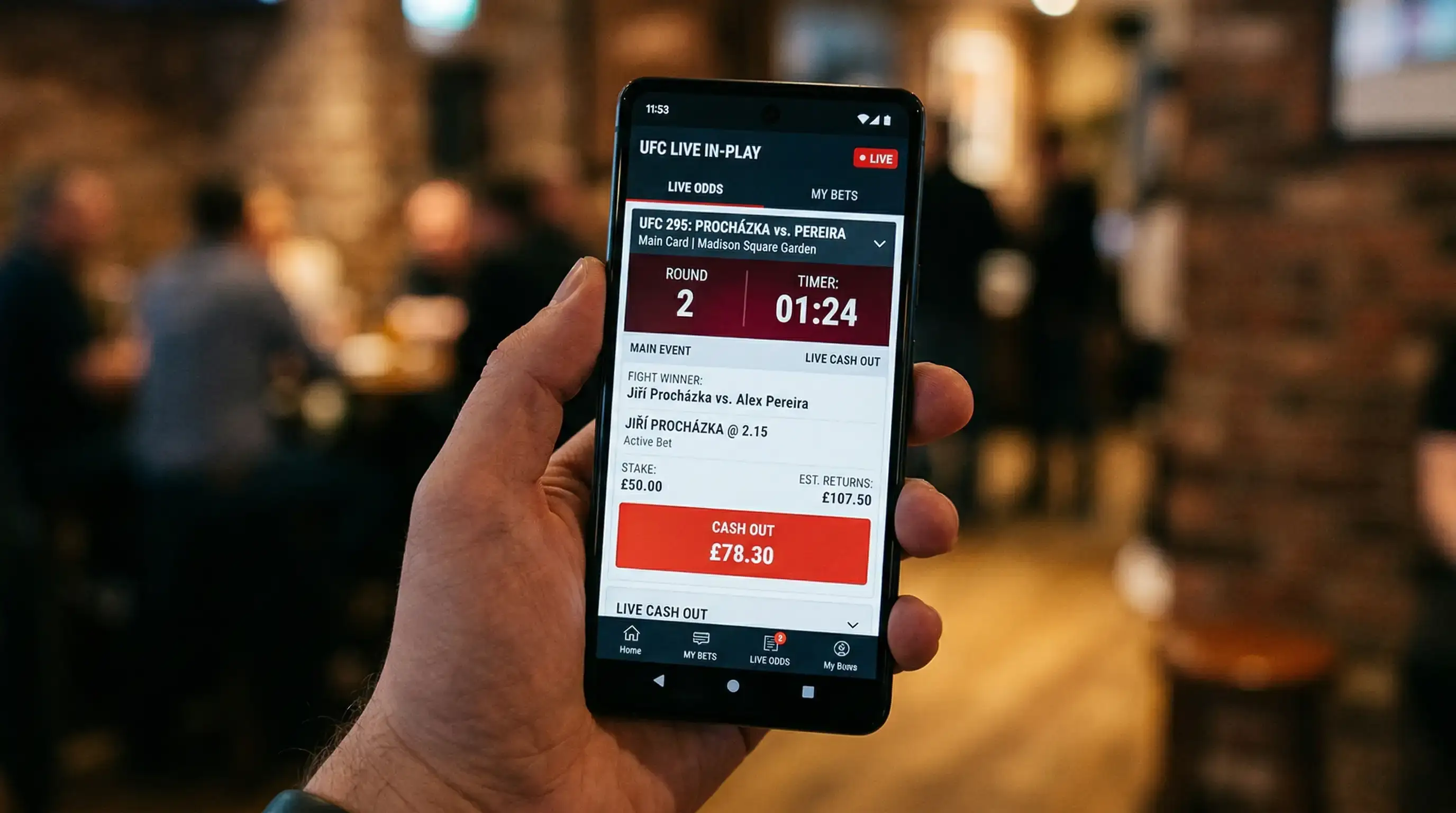
First, product depth will continue to expand. Operator competition for the growing online betting base is concentrated on product differentiation, which includes MMA-specific features. Bet builder improvements, cash-out enhancements, in-play infrastructure upgrades and promotional offers on UFC cards will continue through 2026 and beyond. The UK MMA betting experience in 2026 is measurably better than in 2024, and the trajectory continues upward.
Second, pricing competition on major UFC events is strong. With 13.5 million active accounts distributed across the major UK operators, each UFC main event generates substantial betting volume that pressures operators to price sharply enough to attract that volume. Margins on UFC main-event moneylines sit around 4% to 6% — tighter than on most other sports in the operator’s portfolios — because the competitive pressure specifically on UFC markets is intense. The broader context of how to extract value from these markets is covered in the piece on UFC odds and value betting for UK punters.
Third, consolidation limits price diversity. The 3.7% reduction in licensed operators over the past year means fewer independent books setting independent lines. Line-shopping across UK sportsbooks still works — different operators still produce different prices on specific bouts — but the variance is narrower than it was five years ago. Serious MMA bettors should maintain accounts across multiple operators to capture remaining line variance, but the edge from pure shopping is gradually compressing.
Fourth, regulatory tightening affects operator promotional activity. The 31 October 2025 deposit-limit prompt requirement, the 1.1% statutory levy on operators’ GGY, and the light-touch financial vulnerability checks triggered above £150 monthly net deposit all compress operator margins and shape how promotions are structured. UK MMA welcome bonuses in 2026 are less generous than their 2021 equivalents in headline terms, and the small-print constraints are tighter. The combined effect on bettor value is small but persistent.
Fifth, the commercial stability of the UK online gambling sector underpins MMA-product investment. Growth at 7% year on year with a 46% market share for remote gambling is the strong-but-stable picture that justifies long-term product roadmaps from operators. UK MMA bettors are operating in an ecosystem that is not about to collapse, contract dramatically, or pivot away from MMA coverage. The product roadmap for the next two to three years is basically visible in the current operator behaviour patterns, and it is consistently positive for MMA-specific depth.
The Shape of the UK Market Through 2027
Looking forward rather than backward, the likely trajectory is continued single-digit growth with gradual regulatory evolution. The 7% growth rate may compress slightly as the market matures, but sustained growth above 3% to 4% is likely across the 2026 to 2027 reporting cycles. Active account counts will continue rising, though more slowly than GGY — the existing bases are stabilising and new account acquisition is becoming incrementally harder. Operator concentration will continue, with the top 5 UK operators likely capturing a growing share of total market GGY.
For UK MMA bettors specifically, the pattern points toward continued product expansion and competitive pricing on major UFC cards, gradual improvement in coverage of non-UFC promotions like PFL, Bellator and KSW, and ongoing regulatory refinement that affects marketing but not core betting functionality. The UK is a mature, well-regulated, commercially expanding market for MMA betting, and the growth data underlying that summary is what the 7% figure represents. Worth paying attention to, even when the specific card on Saturday is more immediately interesting than the UKGC’s quarterly bulletin.
How much of UK online gambling growth comes from sports betting vs casino?
Online casino typically grows faster than online sports betting in percentage terms, but both contribute meaningfully to the 7% aggregate figure. Remote Casino, Betting and Bingo grew 13.1% year on year in the latest reporting cycle, while remote sports betting grew at more moderate single-digit rates. The casino side drives much of the headline expansion; sports betting including MMA grows at a steadier, lower rate underpinning the overall market.
Does the drop in retail betting shops affect MMA pricing online?
Indirectly yes. Retail decline accelerates operator investment in online product including MMA-specific features, which tightens pricing competition on major UFC events and expands promotional activity. The specific pricing on MMA markets does not depend on retail dynamics directly, but the operator resources redirected from retail toward digital product development benefit UK MMA bettors through deeper markets and sharper main-event pricing.
Prepared by the mma Betting Online editorial staff.