UFC Cash Out Betting and Live Profit Tools
 Available in US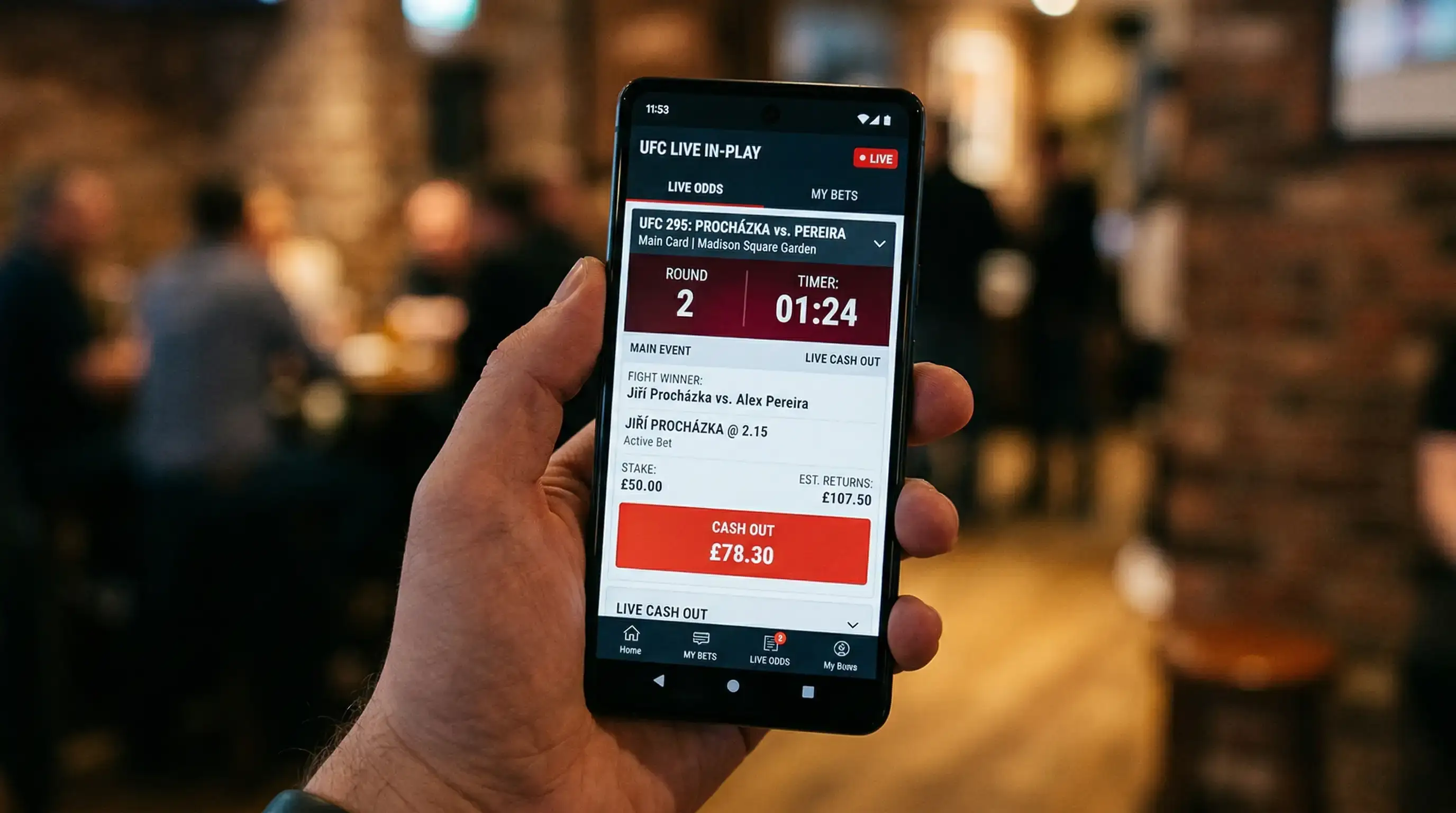
Securing Live Profits With UFC Cash Out Betting Features
I sat behind a reader in a Manchester pub last November while he agonised over a cash-out offer on a UFC co-main. His fighter had won round one convincingly. The app was offering to settle his £20 moneyline at £31 instead of the full £44 potential. He tapped it. Two rounds later his fighter lost a split decision. He looked heroic for ten minutes and then looked hollow for the rest of the night when he realised the book had sold him something worth £44 in pure probability for £31 in actual cash. Every cash-out interaction is a transaction, and most UK bettors do not read the transaction carefully.
Cash out is the most widely used in-play feature on UK sportsbooks and one of the least mathematically understood. The button looks like a courtesy — a way to lock in profit or limit loss before a fight ends — but what it actually offers is a transaction priced with a significant operator margin embedded, typically 5% to 15% worse than the neutral fair-value settlement of the position. That margin is the book’s profit, and it is why cash out exists as a product in the first place.
This piece breaks down how UK books calculate cash-out prices, when the button is mathematically correct to press, and why most bettors lose value by using it reflexively rather than deliberately. The broader in-play context sits in the piece on UFC live and in-play betting on UK sites, which covers the mechanics of live markets more broadly.
How a UK Book Calculates a Cash-Out Price
A cash-out offer is the operator’s calculation of what your current bet is worth if settled now, minus the operator’s cash-out margin. The first part is a probability calculation; the second part is a profit skim. Both are happening in real time and the bettor sees only the net number.
The probability calculation looks at the current live odds on your fighter winning. If you bet Fighter A pre-fight at 2.50 and Fighter A is now priced 1.40 mid-fight, the probability of winning has shifted from roughly 40% to roughly 71%. Your £20 stake that would have paid £50 gross at 2.50 now has a current-value expectation of £20 × 1.40 = £28 at the new implied probability. That is the fair-value settlement of your position before the book takes its margin.
The operator then applies its cash-out margin. UK books typically skim 5% to 15% off the fair-value number depending on market liquidity, the specific fight, and the operator’s commercial policy. If the fair-value settlement is £28 and the operator’s cash-out margin is 10%, the number that appears on your screen is £25.20. You have taken £25.20 to walk away from a position worth £28 in probabilistic terms. The £2.80 difference is the operator’s profit on the cash-out transaction.
The book’s motivation to offer cash-out is mostly risk-management rather than courtesy. When bettors cash out winning positions early, the book reduces its liability on outcomes that otherwise might pay out in full. When bettors cash out losing positions to recover partial stake, the book keeps the margin on a bet it might otherwise have had to refund under voiding rules. Either way, cash-out generates incremental operator revenue by embedding a margin on transactions the bettor initiates voluntarily.
An industry trader once captured the commercial logic — in a comment about a result-heavy week of sports betting: “Obviously, for bookmakers, it was a Cheltenham to remember. It’s very rare that so many well fancied shots get beaten, so there was definitely no moaning from our side.” The same principle applies to cash-out. Operators know the volume of voluntary transactions on cash-out is substantial, and the embedded margin is reliable incremental revenue. The 7% year-on-year growth in UK online gambling GGY reflects this kind of product-level revenue expansion, not just increased wagering volume.
The margin on cash-out is typically higher than the margin on the original moneyline the bet was placed on. A UK book might run a 4% to 6% margin on a UFC main-event moneyline and a 10% to 15% margin on cash-out offers on the same fight. You are paying a premium for the early-settlement convenience, and the premium is not advertised anywhere on the interface.
Partial vs Full Cash Out on MMA Slips
Most UK books offer two cash-out modes: full, which settles the entire bet at the offered price, and partial, which settles a proportion of the bet and leaves the remainder in play. The partial option is more flexible but carries a different cost structure that changes the analysis.
Partial cash-out lets you lock in a guaranteed profit on part of your stake while maintaining exposure to the full-settlement outcome on the remainder. If your £20 bet on Fighter A at 2.50 is offered a full cash-out of £28, the partial cash-out screen lets you settle, say, £12 of the £20 at the proportional value and leave £8 still in play at the original 2.50 price. You bank the £12 proportional settlement and still win or lose the remaining £8 at full 2.50 price if the fight runs to a settlement.
The margin on partial cash-out is typically the same percentage as the full cash-out, applied proportionally. So if the full cash-out carries a 10% margin, the partial settlement on £12 stakes worth also carries the same 10% margin. You are not getting a better per-pound deal by splitting the transaction, but you are preserving optionality on the remaining stake.
Accumulator slips complicate partial cash-out significantly. If your four-fight UFC accumulator has one leg settled, two legs in play, and one leg still to start, the partial cash-out calculation has to account for the remaining probability on each leg individually. Most UK books handle this with software that produces a single cash-out number covering the entire slip rather than leg-by-leg, but the margin applied to multi-leg cash-out is usually wider than the single-fight version — sometimes 15% to 20% on complex slips. Acca cash-out is the market where operator profit is largest in percentage terms and where bettor value is smallest. Think carefully before hitting the button on a multi-leg slip.
The related piece on acca insurance on MMA accumulators covers the interaction between cash-out and acca insurance terms — specifically, cashed-out legs are usually excluded from insurance eligibility, which means using cash-out on a slip can forfeit insurance coverage that would otherwise have protected the remaining exposure.
Auto Cash Out: Useful Rule or Expensive Habit?
Auto cash-out lets you pre-set a threshold — a profit level or a loss level — at which the book automatically executes the cash-out when the offer reaches that figure. It looks like a disciplined feature but behaves in practice like a margin-extraction device that most bettors would do better without.
The design logic of auto cash-out is to prevent bettors from “missing the moment” where cash-out offers peak during a fight. A fighter might be dominating round one, have a cash-out offer that peaks at £40, and then slip into a tougher round two where the offer drops to £25 before rebounding to settlement. Auto cash-out at £35 would have captured the £35 on the way up, regardless of whether the user was watching the app.
The problem is that the offers that trigger auto cash-out are systematically the offers with the highest margin embedded. When a fight is most in your favour, the book’s cash-out offer reflects the most favourable fair-value calculation from your perspective — which is precisely when the book is willing to apply the widest margin because the bettor’s motivation to take it is strongest. Auto cash-out triggers on exactly the transactions where operator profit per pound is highest, which means auto cash-out is a tool that structurally maximises the bookmaker’s margin capture rather than the bettor’s.
A more disciplined alternative is manual cash-out review at fixed intervals — between rounds of a UFC fight, for instance. You open the app between rounds, see the current cash-out offer, and decide whether to act on it with full attention rather than reflexively. Between-round markets in UFC are a specific in-play window where offers can spike briefly, and the bettor’s analytical discretion during that window beats algorithmic execution in most cases.
The UFC pricing context matters here. Favourites win roughly 72% of UFC fights, and the implied probability in cash-out offers on favourites reflects that baseline with adjustments for in-fight performance. When a favourite is winning rounds convincingly, the cash-out offer approaches the pre-fight price fairly closely. The room for margin extraction is larger when the fight is closer to a toss-up at mid-fight, which is why auto cash-out targets set at “break-even after one round won” or similar midpoint triggers tend to be where the book’s margin hits hardest.
The Few Clear Cases Where Cash Out Is Correct
Cash-out is mathematically correct to use in a specific set of circumstances where the embedded margin is outweighed by a risk-management or information-based consideration. These cases exist but they are narrow.
Case one: fighter injury becomes visible mid-fight. If your fighter has clearly hurt a knee, is nursing a rib injury, or is moving in a way that suggests a looming finish, cash-out locks in the probability before the visible deterioration is fully priced into the live line. This is specifically a case where your information precedes the book’s pricing update, and the cash-out offer at that moment still reflects the pre-injury probability. The window is brief — sometimes only 30 to 60 seconds — but the EV on those specific cash-outs is genuinely positive. This is the only clear information-driven case where pressing the button generates mathematical value.
Case two: bankroll emergency. If you have overstaked a position and the variance on the remaining minutes of the fight represents a disproportionate share of your bankroll, cash-out is a rational risk-management tool even at a 10% margin. You are paying the margin to reduce variance on a position that should not have been as large as it is. The correct lesson from the trade is to size positions better in future; the cash-out itself is damage control rather than edge generation.
Case three: contrarian liquidity. On Betfair or similar exchanges, cash-out equivalent — laying off the position at current exchange prices — sometimes becomes genuinely favourable when sportsbook cash-out offers lag the exchange pricing. This is an arbitrage window rather than a cash-out in the conventional sense, but it is the most reliable positive-EV use of early settlement on UFC in-play markets. The operational complexity means it only matters to bettors running accounts across multiple books and exchanges simultaneously.
Everything else — cashing out to “lock in profit”, to “hedge a bet builder”, to “limit loss on a fading favourite” — is essentially paying the book a margin to reduce your exposure. Sometimes that trade-off is worth making for psychological reasons. It is almost never worth making for mathematical reasons. The honest mental model is: cash-out is buying an option from the book at a price that favours the book. Buy it when the option is genuinely valuable to you. Refuse it otherwise.
One final framing. The most profitable long-run UK MMA bettors I know press cash-out maybe twice a year. They bet at stake sizes they are comfortable with, they accept the variance on positions that do not go their way, and they treat the button as an emergency mechanism rather than a default tool. That discipline is what the maths recommends. Nothing about the feature’s design makes it easy to follow.
Do UK bookmakers offer cash out during active rounds or only between them for UFC?
UK operators typically offer cash out continuously during active rounds on most UFC markets, with brief suspension windows of a few seconds around significant fight events — knockdowns, visible injuries, referee warnings. Between-rounds periods are when offers refresh with the clearest updated pricing, and the liquidity is deepest in those windows. Mid-round offers carry slightly wider margins than between-rounds offers because the volatility is higher and the book’s risk premium scales with it.
Is cash-out value worse on MMA parlays than on single fight bets?
Yes, measurably. Cash-out margins on multi-leg accumulators are typically 15% to 20% against 5% to 15% on single-fight bets. The multi-leg calculation compounds the operator’s risk premium across each leg, and the complexity of the calculation provides additional cover for wider spreads. Cashing out a four-leg UFC acca with two legs settled and two pending will typically leave the bettor worse off in fair-value terms than cashing out any of the remaining legs individually would have done.
Created by the ”mma Betting Online” editorial team.