UFC Bet Builder Markets and Custom Correlated Odds
 Available in US
Selecting Correlated Legs for UFC Bet Builder Slips
A reader showed me a six-leg UFC bet builder slip last March that he was convinced was a genius play: Fighter A to win, Fighter A to win by submission, fight to end inside the distance, fight to go past round one, Fighter A by submission in rounds two or three, total rounds under 2.5. Six legs, all from the same fight, priced at 25.00 decimal on his UK sportsbook. I worked out the fair combined price based on the correlations between those specific outcomes. It was roughly 15.00 decimal. He was paying a 60% margin for the convenience of building the slip as a single product.
Bet builder is the UK sportsbook industry’s fastest-growing product line over the last five years. It generates margins that would make moneyline traders weep with envy. Most UK MMA bettors treat it as a strategy tool for exploiting fighter-specific views. The book’s view is that it is a margin-extraction engine disguised as a customer-empowerment feature. Both are partly right, but the maths favours the book heavily on most slips customers actually build.
This piece works through the mechanics of UFC bet builder across UK sportsbooks, which correlated legs books allow and which they block, how to estimate fair combined odds yourself, and where the genuine value positions sit in the rare cases where they exist. The broader markets piece on UFC betting markets on UK sites covers the individual legs; this piece is specifically about combining them.
If you are combining multiple selections, it is vital to check the specific rules regarding acca insurance for MMA accumulators to secure a potential refund.
How Bet Builder Works Across UK Books
The mechanic is simple on the surface. You select two or more outcomes from the same UFC fight — fighter to win, method of victory, total rounds, fight to end inside distance — and the bet builder software combines them into a single slip with a composite price. If all legs hit, you win; if any leg misses, you lose the whole thing.
The composite price is where the interesting mathematics lives. Individual legs each carry the book’s standard margin — 4% to 6% on main-event moneylines, 10% to 15% on method markets, 8% to 12% on round totals. When the book combines these into a single bet builder price, the margin compounds multiplicatively rather than additively. A three-leg slip with 5%, 10% and 10% margins embedded on each component carries a compound margin of roughly 27% on the combined product — substantially wider than any individual leg’s margin.
UK books apply correlation adjustments on top of the multiplicative margin compound. If two legs are positively correlated — “Fighter A to win” and “Fighter A by KO/TKO”, for instance — the true combined probability is higher than the product of the individual probabilities would suggest, because the two outcomes are not independent. The book’s adjustment reduces the combined price to reflect that correlation, but typically by less than the true correlation would justify, leaving additional margin in favour of the operator.
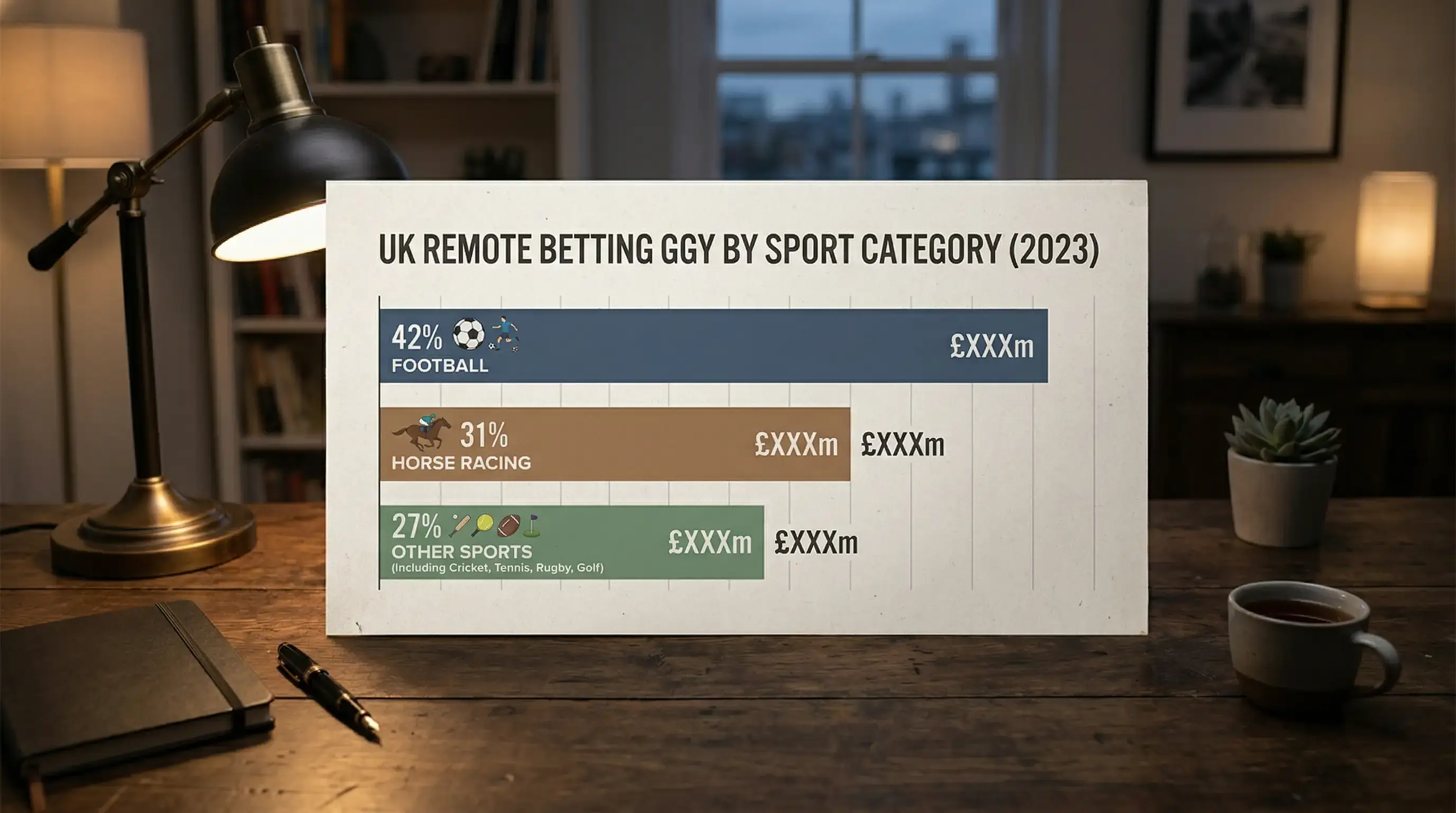
The rapid expansion of bet builder as a product correlates with broader UK online gambling growth — 7% year-on-year increases in total remote-betting GGY and 13.5 million monthly active online accounts in the latest reporting cycle. Operators have invested heavily in bet-builder interfaces precisely because the margin structure is more favourable than almost any other sportsbook product. The marketing is customer-facing; the product economics are operator-facing.
The two operators that together control over half of UK sports-betting paid-click share have invested aggressively in bet builder product development. Pre-constructed “boosted” bet builders are often genuinely good value — the operator is buying customer volume by reducing margin on selected products — but they are a narrow subset of the broader bet builder universe, and building your own combinations typically leaves full margin intact.
Correlated Legs Books Allow vs Block
Not every combination of outcomes can be stacked into a UK bet builder. The books block specific combinations that are too strongly correlated, either because the combined probability approaches certainty or because the correlation creates arbitrage vectors against the rest of the book’s positions.
Allowed combinations typically include: fighter to win plus method of victory (KO/TKO, submission, decision); fighter to win plus total rounds (over/under various thresholds); method of victory plus total rounds; fight to end inside distance plus specific-round outcomes; under 2.5 rounds plus KO/TKO method. Most standard fight-outcome combinations are available on UK bet builders.
Blocked combinations include: fighter to win by KO in round one plus fight to end in round one (fully redundant outcomes); under 1.5 rounds plus fight to go past round one (mutually exclusive); specific fighter to win by decision plus fight to end inside distance (contradictory). The books block redundant and contradictory combinations because the composite probability is either 100% (trivial win) or 0% (trivial loss), which breaks the product’s risk-management logic.
The interesting blocks are the ones that are not obviously trivial. Some UK books block combinations like “Fighter A by submission” plus “Fighter A by KO/TKO” — the fighter can only win by one method, but the combination is not trivially zero because of the “if the bet builder is technically allowed, only one leg will settle as correct and the other as incorrect” logic. The book blocks these because the payout on any single leg being correct would make the multi-leg slip effectively a single-leg bet at a worse combined price. Closing this loophole is standard industry practice.
The restrictions that catch most UK bettors by surprise involve cross-fight bet builder. Traditional bet builder is within a single UFC fight. Some UK books now offer multi-fight bet builder — “UFC 300 bet builder” or “Saturday night bet builder” — which lets you combine legs across different fights on the same card. These products often carry even wider compound margins than single-fight bet builder because the independence assumption holds more cleanly across fights, which means the book has less reason to apply correlation adjustments in your favour.
Estimating Fair Combined Odds Yourself
The honest way to evaluate any bet builder slip is to estimate the fair combined odds yourself and compare against the book’s offered price. If the book’s price is significantly shorter than fair value, the margin is too wide for the bet to carry positive expected value even with your analytical edge on the individual legs.
The baseline calculation starts with individual fair-value probabilities for each leg — your own estimates, not the book’s implied probabilities from the posted odds. Multiply the probabilities across legs, then apply correlation adjustments. For independent or near-independent legs, simple multiplication works reasonably. For correlated legs, you need to adjust upward — sometimes substantially.
A worked example. Fighter A priced at 1.80 to win (55.6% implied); you estimate the true probability at 60%. Fighter A by KO/TKO priced at 3.50 (28.6% implied); you estimate true probability at 30%. Under 2.5 rounds priced at 2.40 (41.7% implied); you estimate 45%. If these were independent outcomes, the combined fair probability would be 0.60 × 0.30 × 0.45 = 8.1%, corresponding to a fair price of 12.35 decimal. The book might offer this combination at 8.50 decimal, which embeds a compound margin of approximately 30%.
But these legs are not independent. If Fighter A wins by KO/TKO, the fight almost certainly ended inside the distance, which pushes the under-2.5-rounds probability dramatically higher conditional on the KO/TKO outcome occurring. The correlation means the combined probability is closer to 0.60 × 0.30 × 0.85 (the conditional probability of under 2.5 given KO/TKO) = 15.3%, fair price 6.54 decimal. The book’s 8.50 offer is no longer 30% margin — it is roughly 23% margin against the correlated fair value. Still wide, but not as catastrophic as the independence calculation suggested.
This kind of manual correlation-adjustment is more work than most recreational UK bettors do. It is also the only way to know whether any specific bet builder slip is being priced fairly or is a margin-extraction trap. The 72% baseline UFC favourite win rate and the divisional finish-rate patterns from the weight-class analysis cascade through these calculations; building the habit of working through the correlations for each combination separates analytical betting from reflexive slip-building.
One shortcut that often works: compare the bet builder price to the simplest equivalent single-leg bet that approximates the same outcome. “Fighter A by KO/TKO in the first three rounds” as a bet builder of win-plus-KO-plus-under-3.5-rounds might be offered at 8.50 decimal. “Fighter A by KO/TKO” straight, without the round restriction, might be priced at 3.50. If you primarily want exposure to Fighter A finishing inside the distance, the 3.50 single-leg captures most of the desired outcome at a fraction of the margin overhead. The bet builder adds specificity; it also adds cost.
Maximize your multi-leg wagers with the latest promotional offers featured on the top UK mixed martial arts betting guide.
Common Mistakes on UFC Bet Builders
Four patterns recur often enough in UK MMA bet building to be worth naming explicitly. Avoiding them will not make you a winning bet builder customer on its own, but making them consistently guarantees you will lose money on the product.
First, building too many legs. Every additional leg multiplies the margin exposure and reduces the probability of a winning settlement. Two-leg and three-leg bet builders can occasionally be reasonably priced; four-leg and five-leg slips almost never are. The mathematical floor of how low the combined probability has to go to produce genuinely interesting returns creates a structural trap: the slips that pay out big are the slips that almost never cash, and the slips that cash often pay out small multiples of stake. Building five or six legs hoping for a large payout is the classic bet builder error and the operator’s preferred customer behaviour.
Second, ignoring correlation in favour of intuition. Recreational bettors often add legs that feel like they should be correlated without checking whether the book has adjusted for the correlation correctly. “Fighter A to win” plus “Fighter A by KO/TKO” plus “fight to end inside distance” feels like one story — Fighter A finishes. In correlation terms it is three legs that partially overlap, and the book’s price should reflect that overlap. Usually it does, which means the compound margin is large even though the legs look correlated. Adding the third leg specifically buys very little additional probability edge over a two-leg version.
Third, using bet builder for exposure available as single-leg bets. “Fighter A in round one” as a bet builder might be priced worse than “Fighter A by KO in round one” as a specific-round method bet. Checking both and picking the cleaner pricing is basic shopping that many bettors skip.
Fourth, chasing bet builder promotions. Some UK books run acca-style insurance on bet builders — if one leg loses, the slip is refunded, typically in free-bet form. The offers sound generous but combine with the already-wide bet builder margins to produce net-negative expected value on the customer side. The promotion costs the operator less than the margin it extracts; that asymmetry is built into the product’s economics.
When Bet Builder Genuinely Beats Single Legs
There are narrow cases where bet builder produces cleaner pricing than the sum of its parts. These mostly involve price-boost promotions on specific combinations and correlation-heavy legs where the book has underadjusted.
Price-boosted bet builders are the cleanest opportunity. When a UK book boosts a pre-constructed bet builder — “Fighter A to win and over 1.5 rounds, boosted to 2.50 from 2.20” — the boost often produces genuinely positive expected value, because the operator is subsidising customer acquisition rather than extracting margin. Boosted bet builders are almost always better value than their individual leg equivalents, and tracking which operators boost which slips each card is a legitimate low-effort edge for UK bettors.
Under-adjusted correlation on specific archetypes also occasionally produces value. Fighter-plus-decision bet builders on wrestler-dominant favourites against strikers can be priced closer to the independent-probability calculation than the true correlation would suggest, because wrestlers often win by decision rather than finish against striker opponents and the book’s correlation adjustment is sometimes too small. These situations are rare but they recur, and they are the specific bet builder combinations where the product earns its place in a disciplined UK MMA betting approach.
Can I bet builder across UFC prelims and main card fights on the same slip?
Most UK books offer cross-fight bet builder only within specific marketed products — ‘UFC London bet builder’, ‘Saturday night multi’, or similar — rather than as a general feature. Building your own cross-fight slip usually requires using a standard accumulator or system bet rather than the bet builder interface. Check the specific operator’s product structure because the rules differ meaningfully across the major UK books.
Why do UK bet builder prices drop so sharply when I add a third correlated leg?
Compound margins multiply across legs, so adding each additional leg adds a margin layer on top of the individual leg’s own margin. Three positively correlated legs also often trigger tighter book-side correlation adjustments than two would, which compresses the price further. The combined effect is that each additional correlated leg typically reduces expected value by more than the stated margin increase suggests, which is why bet builders longer than three legs rarely make mathematical sense.
Published by the mma Betting Online team.