
UFC Method of Victory Betting and Submission Odds
 Available in US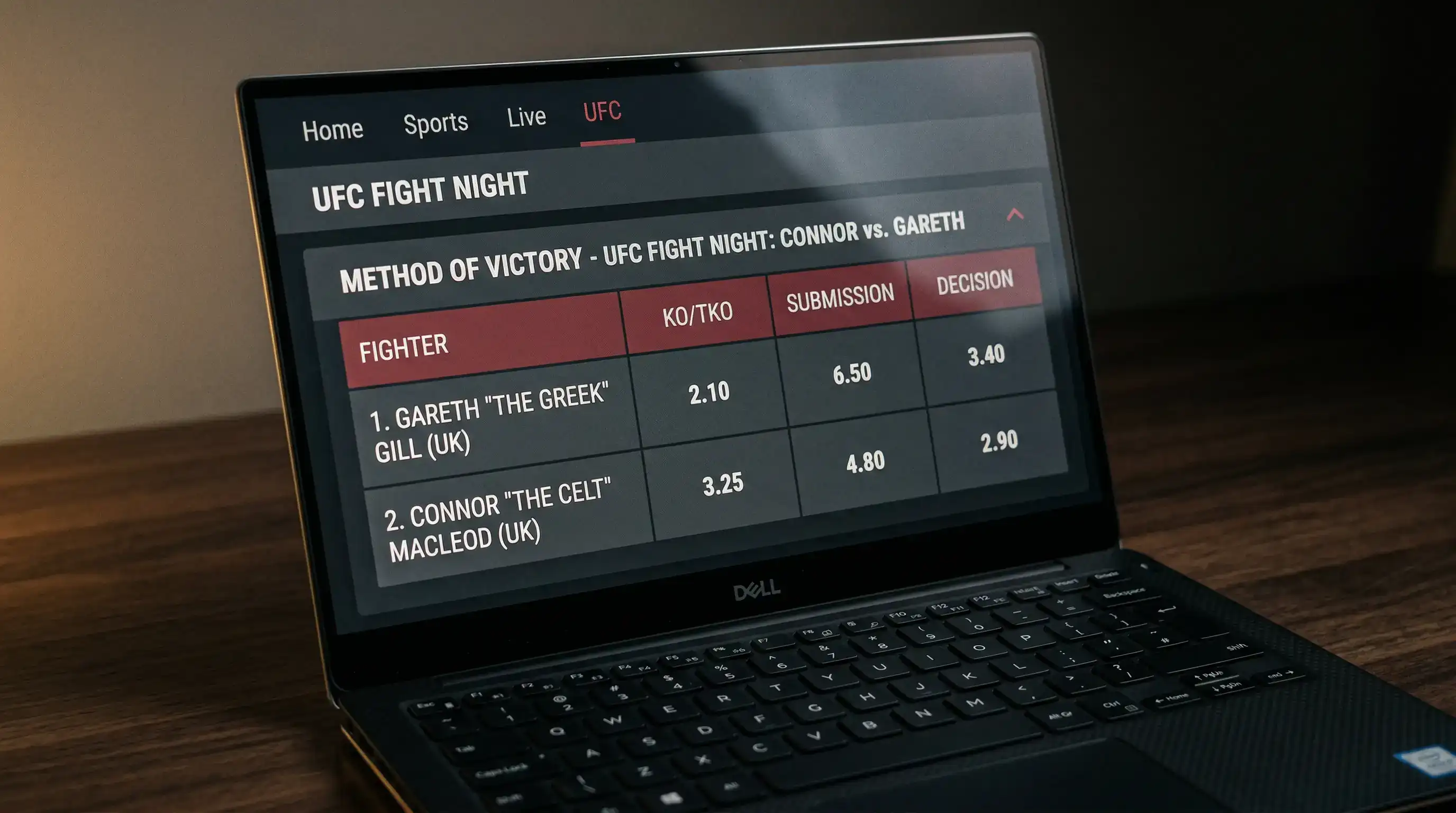
Modeling Knockout and Submission Odds in Method of Victory Pricing
A UK book’s head trader once told me, over a pint at a gambling industry event, that method-of-victory markets were “where we make back what we lose on moneylines.” He was being candid in a way that does not usually make it into press releases. The margin structure on method markets is wider, the pricing is noisier, and the opportunities for a disciplined bettor cut in both directions — some fights are dramatically underpriced on specific method lines, others are dramatically overpriced. Getting the analysis right requires understanding how the book builds the prices in the first place.
Moneylines are simple by comparison. Two outcomes, one probability distribution. UFC favourites win roughly 72% of fights, the market prices around that baseline with fighter-specific adjustments, and the pricing converges to something close to efficient on main events where liquidity is deepest. Method-of-victory markets fragment that binary distribution across four to six outcomes — KO/TKO for each fighter, submission for each fighter, decision for each fighter, occasionally a draw or no-contest line — and each fragment carries its own modelling error. Errors do not cancel; they accumulate.
This piece walks through how UK books actually construct method lines, where the common mispricings occur, and how a UK MMA bettor can identify the method markets that offer genuine value. The foundational piece on UFC betting markets on UK sites covers the mechanics of placing these bets; this piece is the pricing-model layer that sits behind how the lines get set.
Splitting a Win Probability Across Finish Methods
The book’s process starts with the moneyline. Fighter A is priced to win, say, 60% of the time. That 60% then needs to be split across the three ways Fighter A can win: KO/TKO, submission, decision. The split is where the model does most of its work, and it is where the mispricings begin.
The typical model starts with each fighter’s career-long distribution of win methods. Say Fighter A has won 40% of their UFC career by KO, 20% by submission and 40% by decision. The book takes that distribution and applies it to the 60% moneyline probability: 24% KO win, 12% submission win, 24% decision win. The opposing fighter’s win probability of 40% gets split the same way using their career distribution. The sum across all six outcomes hits 100%, which is the mathematical requirement, and the book converts each probability to a decimal price with its margin applied.
Against the 72% baseline for UFC favourites overall, this produces reasonable first-pass prices but misses several fighter-specific and matchup-specific adjustments that matter. A Tom Aspinall method line derived from his 100% finish rate should not include a meaningful decision probability, because he has never gone to a UFC decision. A Paddy Pimblett method line derived from his recent top-ten decision-heavy performances should weight decisions higher than the career-average approach suggests. Weight-class divisional finish rates — heavyweight at 80%, flyweight at 35% — should scale the baseline distributions fighter-by-fighter rather than applying a generic split.
Most UK books now apply weight-class adjustments and recent-form adjustments to the baseline, but the precision varies. Sharp trading desks at larger operators apply granular adjustments; smaller books use simpler heuristics. The divergence between different UK books’ method prices on the same fight is typically larger than the divergence on moneyline prices — sometimes 20% or more in implied probability on the same method leg — which is a clear signal that the model layer is less consistent across the industry than the moneyline layer is. Shopping across books for method prices genuinely beats sticking with one operator.
One structural note. Draws and no-contests occur in under 2% of MMA fights, which is why moneyline markets on UFC can be two-way rather than three-way without introducing significant mispricing. Method markets generally include a “draw” line at very long prices to absorb the residual probability, but the pricing of that line is almost always too short because operator margins concentrate on thin markets. Draw lines on UFC method markets are a no-touch zone for disciplined bettors. The expected value is badly negative regardless of fighter.
Grappling, Striking and Stylistic Modifiers
The stylistic adjustments that separate a sharp method model from a lazy one are where the real pricing work happens. Two fighters with identical career win distributions can produce completely different method probabilities depending on how their styles interact.
Start with the grappling-striking axis. A striker facing a grappler produces a method distribution heavily weighted toward the striker’s KO/TKO line and the grappler’s submission line, with decision probability suppressed relative to either fighter’s individual career baseline. The reason is that stylistic mismatches tend to produce decisive exchanges: the striker either lands the knockout or ends up being controlled on the ground and submitted, with less middle-ground scoring than the fighters’ individual records would suggest. UK books that do not adjust for this correlation produce prices on decision lines that are structurally too short for grappler-versus-striker matchups and too long for striker-versus-striker or grappler-versus-grappler matchups.
Wrestling dominance changes the picture again. A wrestler with strong top control but limited finishing ability converts most wins into decisions, even against finish-prone opponents, because the wrestling game neutralises the opponent’s finishing tools without necessarily producing a submission or KO. Fighters who fit this profile — the Khabib Nurmagomedov archetype, or Sean Brady at welterweight — have method distributions that skew dramatically toward decision wins, and the market rarely prices this correctly against sub-1.50 favourites in their matchups. Decision-side method bets on wrestler-dominant favourites are a recurring value position across UK books.
The corner-assignment question comes up here too. The Carnegie Mellon analysis of 6,478 UFC fights showed red-corner fighters winning 55% to 65% of bouts historically, with the gap narrowing since 2015 as divisional parity has increased. That affects method-line pricing because red-corner matchmaking priority correlates with fighter experience, and experienced fighters are more likely to win by decision than by finish — which means the red-corner method distribution tilts slightly toward decisions against generalised expectations. UK books that do not adjust for this produce a small but persistent misprice on red-corner decision lines.
Layoff length is another stylistic modifier the market handles imperfectly. Fighters returning from long layoffs — over 18 months — show measurably different performance distributions in their first fight back. Finishing ability tends to degrade first, with striking timing taking longer than wrestling strength to return. A post-layoff fighter’s method distribution should weight submission and decision higher, and KO lower, than their pre-layoff career averages suggest. UK books do not adjust systematically for layoff length, so method markets on returning fighters are often mispriced in predictable directions.
Where UK Books Commonly Misprice Method
Certain structural mispricings recur across the UK MMA market frequently enough to be worth naming as specific value targets. These are not clever fighter-specific angles; they are patterns that apply across large samples of fights.
First, decision lines at flyweight and bantamweight are systematically short. The divisional decision rate at flyweight runs 60% or higher, and at bantamweight 50% or higher, but UK book method prices often apply generic UFC-level decision probability estimates that sit closer to 40%. The result is decision-side prices that are shorter than the underlying probability supports. Over large enough samples across flyweight and bantamweight fights, flat-stake bets on favourite decision lines generate positive expected value at UK book closing prices.
Second, KO/TKO lines on heavyweight favourites are priced too short on the “specific round” derivatives. A heavyweight favourite priced 1.50 on the moneyline, 2.00 on win by KO/TKO, might appear at 3.50 on win by KO in round one. The underlying first-round KO probability for most heavyweight favourites is closer to 35% than the 28.5% implied by 3.50 decimal. The specific-round finish markets are where the book’s pricing model breaks down most visibly in the heavyweight division.
Third, submission lines on grappling-heavy fighters are often inflated because recreational money concentrates on KO outcomes and leaves submission markets under-bet. This is a volume-skew effect rather than a model error, but the consequence for the disciplined bettor is the same: submission prices on strong-grappler favourites tend to stay longer than their underlying probability supports, creating occasional value positions against the 72% favourite-win baseline.
Fourth, decision lines on returning fighters after long layoffs tend to be priced too short because the book applies the pre-layoff career distribution without the layoff adjustment. First-fight-back UFC fighters win by decision at rates 8% to 12% above their pre-layoff averages, and the method markets do not reflect this adjustment consistently.
Fifth, co-main event method prices carry the same structural 40% upset rate distortion as the moneyline market, but the method lines scale the distortion into the fragmented outcomes. A co-main underdog’s “win by KO/TKO” line can be systematically longer than the combined underdog-win probability and finish-given-win probability would support. Compound mispricings like this are where portfolio positions across co-main method lines generate the cleanest long-run returns on UK books.
Finding Mispriced Method Lines Without Overthinking
A disciplined approach to method markets does not require building a full probabilistic model. It requires recognising which of the common mispricings apply to the specific fight in front of you and sizing stakes proportionally to the edge.
Start by reading the moneyline against the divisional baseline. A UFC favourite priced 1.50 is being modelled at 66.7% to win against the 72% UFC-wide baseline, which means the market sees this fighter as slightly below-average for a favourite. That framing shapes the method analysis: a below-average favourite is more likely to go the distance than an average favourite, which means decision lines on the 1.50 side are more likely to be correctly priced or slightly long. A heavy favourite at 1.25 against the 72% baseline implies 80% win probability, well above average, which concentrates finish probability at the expense of decision probability and creates potential value on specific-round finish markets.
Then filter by weight class. Heavyweight and light heavyweight fights prioritise finish markets in your analysis because 70%+ of these fights end inside the distance. Lightweight and below prioritise decision markets. Middleweight and welterweight sit in the middle and require matchup-specific adjustment. This quick filter alone eliminates most of the method markets where you are likely to find edge and focuses attention on the small subset worth deeper analysis.
Finally, check the specific fighters against their career distributions and recent form. If the book’s implied method probabilities diverge materially from what the fighter histories suggest, there is either a mispricing or a stylistic adjustment the market is pricing that you should understand. Either way, working through the check is what separates methodical betting from recreational punting.
One final observation. Method-of-victory markets carry wider margins than moneylines — typically 10% to 15% against 4% to 6% on main-event moneylines — which means even correctly identified mispricings need to clear the margin overhead before becoming profitable. The edges that survive the margin are real but they are rarer than they look. Betting every method line you think is slightly off will produce aggregate losses because the cumulative margin eats any imprecise edge identification. Selective action on the cleanest setups is how method-market edge compounds over time.
Why do decision prices drift shorter on UK books the closer a UFC fight gets?
Sharp money tends to flow into decision markets as fight week progresses because experienced analysts identify decision-prone matchups faster than the opening-line models do. The closing-line movement shortens decision prices to reflect that sharp money, while recreational volume continues to concentrate on finish outcomes. Decision-line CLV is often most easily captured at opening prices before the sharp late action moves the market.
How should I treat method-of-victory lines for fighters coming off a long layoff?
Adjust toward higher decision probability and lower KO probability than the fighter’s pre-layoff career average suggests. First-fight-back performances show finish rates 8% to 12% below prior career baselines because striking timing degrades before grappling strength returns, and the market rarely prices this adjustment consistently. Decision-side method bets on post-layoff favourites are a specific value archetype that recurs reliably on UK books.
Prepared by the mma Betting Online editorial staff.