UFC Finish Rates and Weight Class Betting Statistics
 Available in US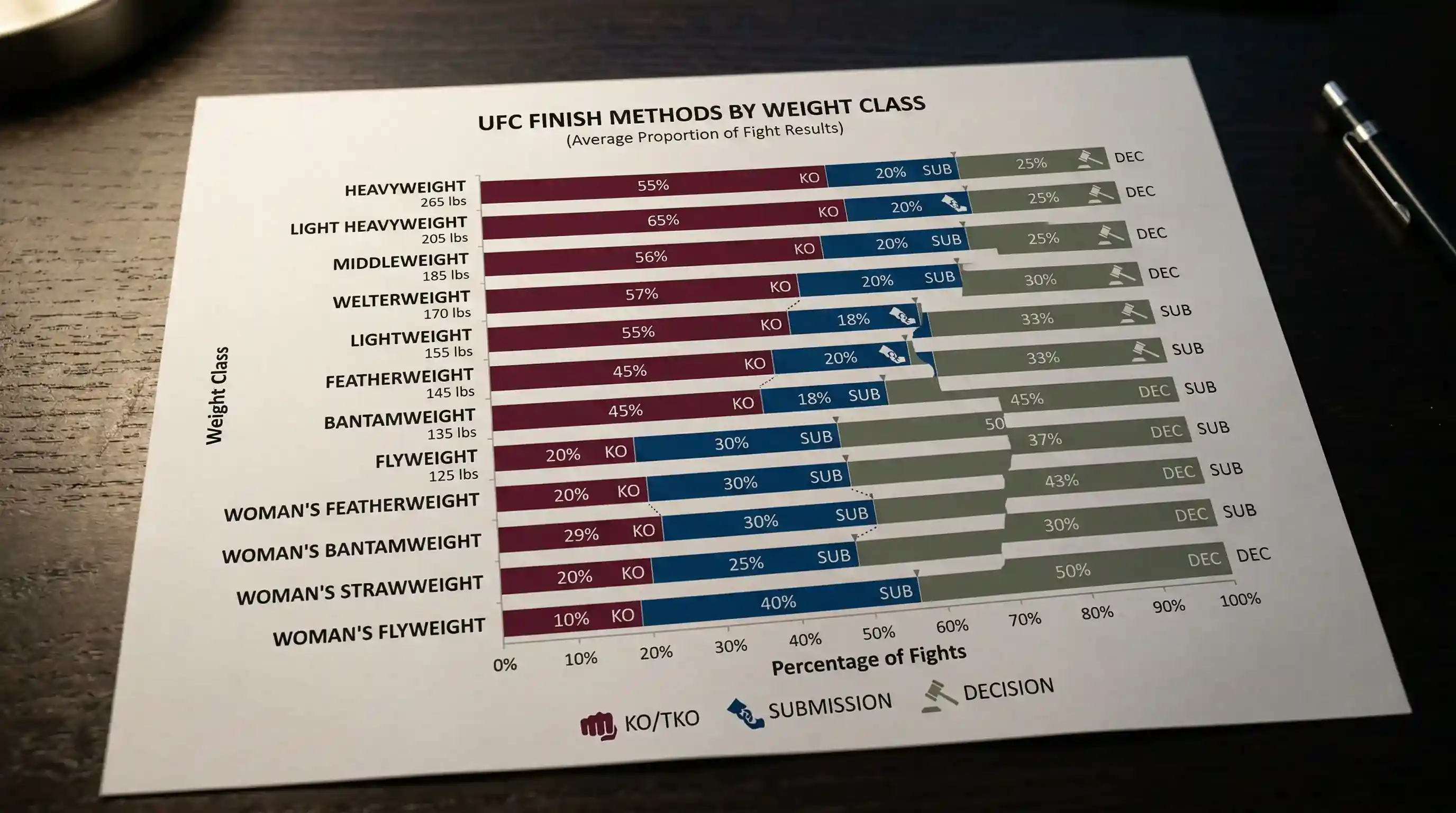
Predicting Stoppages Using UFC Finish Rates by Weight Class
I ran the numbers one Saturday morning last autumn on a decade of UFC fight data and sent the output to a bettor friend who had been complaining about losing consecutive round-betting slips. The chart showed finish rate by weight class, and he stared at it for a minute before messaging back: “I’ve been betting heavyweight overs and flyweight unders.” He was doing the exact opposite of what the distributions demanded. He is not alone. Round betting is the market where weight class matters most and where most UK bettors pay the least attention to it.
The broader baseline worth starting with. Across all UFC fights, favourites win roughly 72% of the time and underdogs take 28%. Draws appear in under 2% of fights, which is why moneyline markets are two-way rather than three-way and why decision markets can be modelled as a single binary outcome without a no-action cushion. Those numbers are the backdrop. The interesting variation sits at the weight-class level, where the distribution of how fights end — KO, submission or decision — varies by a margin larger than almost any other structural feature of the sport.
This article walks through the finish-rate distribution by weight class, what drives it, and how to turn the pattern into sensible round-betting positions on UK sportsbooks. The relevant companion piece is the one on UFC betting markets on UK sites, which lays out the mechanics of round, over/under and method-of-victory betting; this piece is the analytical layer that sits on top.
Heavyweight and Light Heavyweight: Short, Violent Books
Heavyweight is the weight class where the statistics have been stable for longest and where the betting implications are clearest. Something close to 80% of heavyweight UFC fights end inside the distance, with the overwhelming majority of finishes coming by KO or TKO in the first two rounds. The physics is simple: 265-pound athletes delivering punches at full extension produce damage that smaller bodies can absorb but heavier ones cannot. Fights end quickly because they have to.
Tom Aspinall’s 100% UFC finish rate is an extreme version of the divisional pattern, not an anomaly from it. Across the division as a whole, first-round finishes account for 40% to 50% of all heavyweight bouts in any given calendar year. Decisions are the exception rather than the norm. A five-round heavyweight main event going to the scorecards is unusual enough that it moves fighter rankings just by virtue of durability; a three-round heavyweight prelim going the distance is a slightly awkward result that neither fighter particularly benefits from.
Round betting implications. “Under 1.5 rounds” and “under 2.5 rounds” lines at heavyweight are systematically longer in price than the underlying probability distribution supports. UK books price these at default settings that reflect a generic fight profile rather than a heavyweight-specific one, and the gap is consistent. Over 2.5 rounds at heavyweight is a bet you should almost never take unless the matchup specifically suggests two durable grappler-striker profiles where neither has a clear finishing advantage. Even then the edge is thin.
Light heavyweight behaves like heavyweight-lite. Finish rates sit around 70%, with a slightly higher submission share and slightly lower KO share than heavyweight. The first-round finish rate drops to 30% to 35%, meaning fights are shorter than in lighter weight classes but longer than in heavyweight. Round-betting lines follow the same pattern of mispricing, just with smaller gaps. Under 2.5 rounds at light heavyweight remains a profitable standing bet over meaningful samples; over 2.5 is the contrarian position that occasionally pays when the matchup is stylistically wrong for a quick finish.
The co-main-event dynamic interacts with weight class here. Roughly 30% of UFC fights with a clear favourite/underdog split end in upsets, rising to 40% for co-main events specifically against 23% for main events. Heavyweight co-mains combine the divisional finish rate with the structural upset rate, which means underdog-to-win-by-KO lines in heavyweight co-mains are a specific niche worth monitoring — the combined probability sometimes clears the implied odds by a meaningful margin.
Middleweight and Welterweight: The Middle Ground
Middleweight and welterweight are the divisions where round-betting analysis becomes genuinely skill-testing. Finish rates in these divisions sit between 50% and 60% — some fighters finish frequently, others almost never, and the distribution within the division is wider than in either the heavy or light weight classes.
At middleweight, high-finish-rate fighters like Dricus du Plessis or Israel Adesanya against lower-finish-rate grinders produce a bimodal distribution. Half of the division fights end inside the distance and half go to decision, and the matchup rather than the divisional baseline determines which side of the distribution any specific fight lands on. UK books price middleweight rounds at roughly the divisional average, which underprices fights between two high-finish-rate fighters and overprices fights between two decision-oriented grinders. The analytical edge is in matchup-specific adjustments rather than blind adherence to divisional averages.
Welterweight is slightly more decision-heavy than middleweight because the division’s deepest talent pool includes multiple fighters whose style rewards cardio and output volume over explosive finishing. Leon Edwards’s fights have gone to decision at a higher rate than his KO-heavy highlight reel suggests. Ian Garry’s fights have trended toward decisions since his ranked appearances began. The divisional finish rate sits around 55% to 58%, with significant variation between top-ten matchups (more decisions) and ranked-versus-unranked matchups (more finishes).
Over 2.5 rounds lines at welterweight are more honestly priced than at heavier weight classes, but under 1.5 rounds at welterweight remains systematically long. First-round finish rates at welterweight sit around 15% to 20%, which is a reasonable probability but not a high one; UK books often price under 1.5 at 3.50 or longer on evenly matched fights, which translates to an implied probability of around 28% — comfortably above the divisional norm. That gap is where recreational money loses over time and where disciplined lay positions pay.
Method-of-victory markets intersect strongly with round markets in these divisions. A fighter who is priced 1.80 to win but whose method-of-victory distribution is 60% decision and 40% finish should have round-betting positions weighted accordingly. UK books price method and round derivatives sometimes independently, sometimes with rough internal consistency, and the inconsistencies are where portfolio plays generate edge.
Lightweight Down to Flyweight: The Decision Zone
The light weight classes are the ones where everything you learned from heavyweight betting inverts. Lightweight finish rates sit around 45% to 50%. Featherweight drops to roughly 40%. Bantamweight and flyweight bottom out at 35% to 40% finishes, meaning the majority of fights in these divisions go the full 15 or 25 minutes. Decision betting is where the value sits in these divisions; method-of-victory markets require significant adjustment for the higher probability of going to the scorecards.
Why the decision skew? Three factors stack. Cardio capacity at lighter weights is higher relative to damage-absorption capacity, which means fights can sustain full rounds without producing the finishing moments heavyweight bouts deliver almost automatically. Defensive technique at the elite end of these divisions is sharper because the talent pool is deeper. And the athletic profile of lighter fighters favours speed and movement over stopping power, which produces exchanges that score points on the judges’ cards without producing fight-ending damage.
Paddy Pimblett’s UFC career illustrates the lightweight pattern well. His method-of-victory distribution against top-ten competition has trended toward decisions, even when he was clearly winning the fights. Arnold Allen at featherweight follows the same pattern — a striker whose output produces decision wins rather than finishes, which creates consistent value on his decision lines against UK book pricing that underweights the divisional skew. Muhammad Mokaev at flyweight is pushing against the divisional trend with genuine finishing ability, but the divisional baseline for flyweight remains decision-heavy to a degree that UK books do not always reflect correctly in their opening lines.
Over 2.5 rounds at flyweight is almost automatically a worthwhile position on any evenly matched fight. The market prices it short because the broader UFC default implies a 50/50 chance of hitting 2.5 rounds, but the flyweight-specific probability is closer to 70%. Even after UK book margins, the implied odds on “over 2.5 rounds” in a flyweight co-main usually leave positive expected value for disciplined bettors. Bantamweight sits close to the same position.
Round-betting variance is also lower in these divisions because fights behave more predictably. A lightweight fight that goes to round three is almost certainly going to a decision; a heavyweight fight that goes to round three is still roughly 50/50 to end by finish in the remaining time. That lower variance makes lightweight and flyweight round lines easier to model but also easier for UK books to price tightly, which compresses available edge but increases consistency for the bettor who is right.
How To Apply This to UK Over/Under Round Lines
The practical framework for applying weight-class finish rates to UK over/under markets comes down to three operations.
First, check the divisional baseline against the UK book’s line. Heavyweight lines should be priced shorter on unders than a generic model suggests; flyweight lines should be priced shorter on overs. Any UK book pricing these markets without a visible divisional adjustment is leaving edge on the table for disciplined bettors. Some UK books are sharper than others on this — the larger books with dedicated MMA trading desks apply the adjustment, the smaller books often do not — but the gap exists consistently across the industry.
Second, check the fighter-specific adjustment. A 100% finish-rate fighter like Aspinall shifts the over/under line away from the divisional average toward an even shorter expected fight duration. A career-decision fighter at lightweight pushes the line in the opposite direction. UK books apply fighter adjustments with varying precision, and the gaps between fighter-specific and divisional-average pricing are where focused round-betting work produces returns.
Third, check the matchup. Two finishers at middleweight create a distribution that skews harder toward finishes than either fighter’s individual profile suggests, because the probability of either producing a finishing sequence compounds. Two decision-oriented grinders at welterweight produce the opposite distribution, with longer fights than either fighter’s individual history would predict. The matchup effect is the hardest to model but the most rewarding to get right, because UK books apply it imperfectly. Favourites still win about 72% of UFC fights overall, but the way they win varies with matchup far more than the market’s default pricing acknowledges.
One final observation. Round betting tends to attract recreational UK money that uses gut feel rather than weight-class analysis. The line you are taking on a flyweight over or a heavyweight under is being set partly by that recreational volume. The edge available to the analyst is real and persistent, but it requires staking discipline — flat stakes on individual fights, not stacking rounds across accumulators — because variance on any single prop is high even when the edge is genuine.
Which UFC weight class has the highest decision rate for round betting purposes?
Flyweight has the highest decision rate, with roughly 60% to 65% of flyweight fights going to the scorecards. Bantamweight and women’s divisions trail closely. The practical consequence is that ‘over 2.5 rounds’ markets in these weight classes are systematically underpriced by UK books operating from generic divisional defaults, and decision-side method-of-victory lines carry genuine value against carelessly priced alternatives.
How does finish rate change for five-round main events vs three-round fights?
Finish rates are slightly higher in five-round main events than three-round prelims, despite the longer duration, because main-event fighters are statistically more likely to carry finishing ability than the division’s lower-ranked participants. The effect is small — roughly 3 to 5 percentage points — and it affects the specific-round finish distribution more than the overall finish/decision split. Under 4.5 rounds at heavyweight main-event level is almost always a priced-short position that rewards lay bets against retail money.
Published by the mma Betting Online team.