
Closing Line Value and UFC Betting ROI Metrics
 Available in US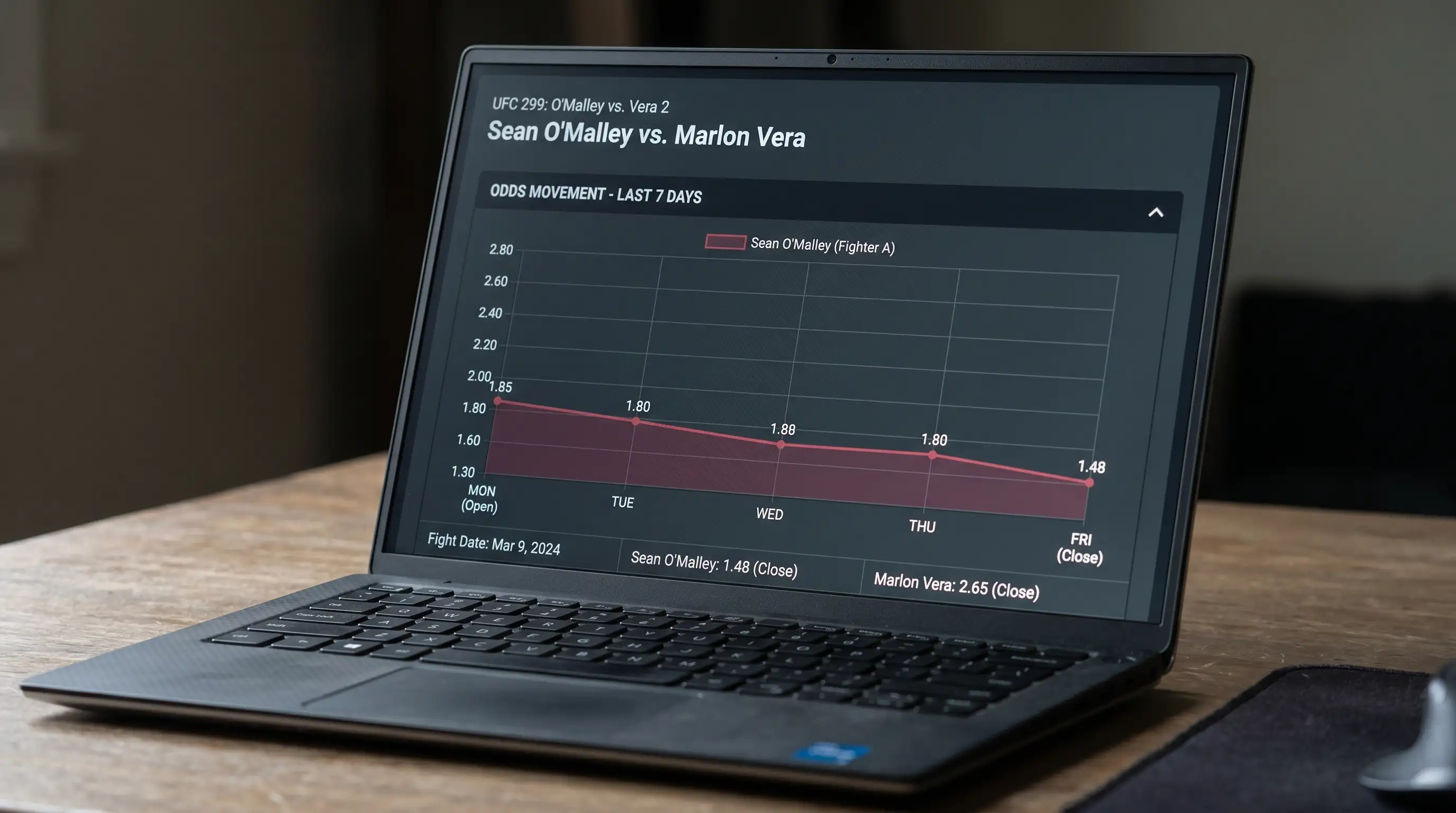
Calculating Long-Term ROI Through Closing Line Value
A bettor I have known for five years keeps a spreadsheet that tracks every UFC bet he places. Most of his columns are the ones you would expect — stake, odds, fighter, fight, outcome. The column he looks at hardest is not any of those. It is the one headed “CLV”. He has been positive on closing line value for three of his last four betting years. In one of those years he was actually down on profit. He does not care. He knows the CLV signal is more reliable than the P&L signal, and the long run has proved him right.
Closing line value is the metric that professional sports bettors use to measure their own edge, and it is the metric most UK recreational punters have never heard of. The simple version: did you bet a fighter at a price longer than the eventual closing line? If yes, you beat the market. If consistently yes, you are genuinely edging against the book over time. Whether any specific bet won or lost is secondary variance; whether you beat the closing line is the primary signal of whether your approach has merit.
This piece explains what CLV is, how to calculate it on fractional and decimal UFC prices, why it predicts long-run edge in MMA specifically, and how to track it without breaching UK book terms. The broader context of odds analytics sits in the piece on UFC odds and value betting for UK punters; CLV is the specific scorecard that sits on top of that broader framework.
Defining CLV for a UFC Market
Closing line value is the percentage by which your taken price beats the closing price on the same market. If you bet a fighter at 2.50 and the market closes at 2.20, you got 30 cents of value — the closing line has moved against the price you took, and the direction of movement confirms that the market agreed with you about the fighter being undervalued at opening. If you bet at 2.20 and the market closes at 2.50, you took a worse price than you would have got closer to showtime — negative CLV.
The underlying logic is that closing odds are the market’s best guess at true probability after all money, all analysis, all news and all late information have been absorbed. Opening odds are a rough initial estimate. Closing odds are the refined version. Beating the closing line consistently means you are systematically ahead of where the market lands, which is the definition of having an edge.
In UFC specifically, closing lines absorb a lot of information in the final 48 hours before a fight. Weigh-ins happen on the Friday evening of most UK card weekends; any weight-cut issues, visible conditioning problems or last-minute injuries get priced in between weigh-in and Saturday night. Sharp money typically moves in late on fights where the early lines were inefficient, pushing the closing line toward fair value. If your opening-price bet beat the closing line after that sharp adjustment, you were ahead of the sharp money — which is a strong signal of analytical edge.
The reverse is also diagnostic. If your bets systematically close at shorter prices than you took them, you are following the crowd or taking positions the market has already moved past. Negative CLV over meaningful samples is a reliable indicator that your approach is losing money over the long run regardless of short-term results. A bettor can win bets while being CLV-negative through pure variance; a bettor who is CLV-negative for a hundred bets is essentially guaranteed to lose money if they continue the same approach.
Calculating CLV on Fractional and Decimal Prices
The calculation is straightforward once you standardise on one format. I work in decimal prices because the arithmetic is cleaner, but the CLV percentage is identical regardless of format.
Decimal example. You bet at 2.50 decimal. Market closes at 2.20 decimal. Your CLV is (2.50 – 2.20) / 2.20 = 0.136, or 13.6%. You beat the closing line by 13.6%. On a £20 stake, that edge translates to roughly £2.73 of expected value above the closing price — assuming the closing price is a reasonable proxy for true fair value, which it usually is for UFC main-event and well-traded co-main markets.
Fractional example. You bet at 6/4 (2.50 decimal) and the market closes at 6/5 (2.20 decimal). Same underlying prices, same CLV of 13.6%. The cleanest way to calculate CLV on UK fractional odds is to convert both prices to decimal first, then apply the decimal formula. Fractional-to-decimal is covered in detail in the piece on fractional, decimal and American UFC odds conversion, which also provides a printable reference table for the common UFC price points.
American-format CLV works the same way. A +150 American price is 2.50 decimal; a +120 closing price is 2.20 decimal; the CLV is 13.6% whether you calculate from the American prices directly or convert first. American format is less common on UK books but appears on global exchanges, so UK bettors running CLV tracking across international odds sources need to handle the format conversion cleanly.
One important subtlety: which closing line? The closing line you beat might differ between the sportsbook where you placed the bet and the sharpest line on the market at close. Pinnacle is the traditional benchmark for “sharp closing line” in global sports betting because their margins are thin and their traders respond to sharp money rather than crowd volume. UK bettors should ideally track CLV against a sharp reference price rather than against the price on their own sportsbook, because the sportsbook they use has a vested interest in keeping closing lines artificially short on fighters that recreational money has piled onto. Exchanges — Betfair and similar — provide a usefully sharp closing price that works as a UK-accessible benchmark.
The market margin — the bookmaker’s overround — needs to be stripped out for precise CLV measurement. A UK sportsbook’s closing line on a UFC fight typically carries a margin of 4% to 8% on main events and higher on undercards, which means the “closing” implied probability you see is slightly inflated above true probability. Adjusting for margin is mathematically straightforward — divide each side’s implied probability by the sum of both sides’ implied probabilities — but most recreational CLV tracking skips the step without losing much signal.
Why CLV Predicts Long-Run Edge in MMA
The predictive power of CLV in combat sports is actually stronger than in higher-volume team sports, for a specific reason. MMA variance is high. UFC favourites win roughly 72% of fights overall, which leaves 28% of bets losing that a modeller predicted would win. With a sample size of 100 bets, a positive-edge bettor can still show a negative P&L through pure variance, and a negative-edge bettor can show positive P&L through the same mechanism.
CLV strips that noise out because it measures whether you are getting better-than-market prices rather than whether you are winning bets. Across hundreds of UFC bets, the correlation between positive CLV and positive long-run P&L is very high — much higher than the correlation between short-term P&L and long-run P&L. A bettor who is consistently CLV-positive will eventually be profit-positive over large enough samples. A bettor who is CLV-negative but profit-positive is on a variance lucky streak that will reverse.
The signal-to-noise ratio is particularly strong in MMA because closing lines move meaningfully. UK books adjust main-event prices multiple times in the final week before a fight based on sharp money, weigh-in outcomes and late injury information. Those movements produce measurable CLV distinctions between bettors who took positions early against the eventual closing direction and bettors who took positions late chasing price movement that had already happened.
The broader efficiency pattern supports the signal. UFC favourites winning 72% of fights is close enough to the market’s implied pricing distribution to make the remaining 28% underdog outcomes the space where edge is actually generated or lost. CLV on underdog bets is typically larger in magnitude than CLV on favourite bets — which makes sense because underdog mispricings are more frequent than favourite mispricings, and the identification of mispricings is where analytical work pays.
One caveat. CLV works best as a scorecard over samples of 50 bets or more. Individual bets can show large positive CLV and lose, or large negative CLV and win, and neither outcome tells you anything about your approach. The pattern emerges at sample sizes most recreational UK bettors do not achieve quickly — if you place 50 UFC bets per year, your CLV scorecard takes a year to generate a meaningful reading. The length of the measurement window is the cost of the signal’s reliability.
Tracking CLV Without Breaking UK Book Terms
UK sportsbooks do not look kindly on bettors who are consistently CLV-positive. The commercial logic is obvious: CLV-positive bettors are systematically beating the book over time, and the book’s response is to limit their stakes, restrict their market access, or in extreme cases close their accounts. This is a real operational risk and it is worth managing carefully if you want to track CLV for edge-diagnosis purposes without triggering account-restriction flags.
The first rule is separation of tracking from staking. Record every bet you place in your own spreadsheet with the price you took, the fighter, the fight date and the closing line. Do not use the book’s own reporting tools to analyse your CLV; build your own database. This keeps the analytical work off the book’s radar while giving you the data you need to diagnose your own approach.
The second rule is stake moderation on highly CLV-positive positions. If you consistently take opening prices that close much shorter, the book’s risk-management system will flag the pattern regardless of whether you win or lose specific bets. Operators run closing-line monitoring on large account samples precisely to identify which bettors are systematically ahead of their lines. The flag rarely triggers account closure at small stake sizes; it routinely triggers limits at larger ones. Staying below the threshold where the book’s attention gets serious is a sustainable strategy for long-term CLV-positive bettors.
The third rule is market diversity. CLV-positive bettors who concentrate all their volume in a single market — say, UFC main-event moneylines — trigger pattern recognition faster than bettors who spread volume across moneylines, method-of-victory markets, round totals and occasional bet builders. The scattered approach also tends to produce more accurate self-diagnosis because strong CLV in one market can be offset by weak CLV in another, and recognising that is useful for refining approach.
Exchanges are the honest alternative for bettors who find themselves limited on sportsbooks. Betfair pricing reflects liquidity rather than promotional margin, and consistent CLV-positive performance is not a reason for exchange restriction. The trade-off is that exchange commissions take a bite out of winning bets, and the liquidity on niche MMA markets can be thin at the opening-price stage when CLV is most extractable. Many long-term UK MMA bettors end up with a hybrid approach — sportsbooks for liquidity at opening lines, exchanges for larger positions as the card approaches showtime — exactly to balance these trade-offs.
The broader UK online gambling landscape grew 7% year on year through 2024/25, with online real-event betting GGY at £2.6 billion and 13.5 million average monthly active accounts. That scale means the books have robust risk-management systems, but it also means there is enormous recreational volume you are implicitly trading against. CLV is how you know whether you are on the right side of that volume.
Is CLV more reliable on UFC moneylines or on method-of-victory markets?
CLV is more reliable on moneylines because the closing line absorbs sharp money efficiently and the two-way binary structure makes the reference price clean. Method-of-victory markets have thinner liquidity, higher margins and less sharp closing action, which means the closing line is a noisier signal. CLV positive or negative on method markets over small samples tells you less about your edge than the same measurement on moneylines.
Can a UK bettor generate CLV data without a paid odds screen?
Yes, through careful manual recording. Note the price you took when you placed each bet, then record the closing price from either your own sportsbook or a sharp reference like the Betfair exchange when the fight starts. A spreadsheet with fifty rows covering a year of bets produces a meaningful CLV scorecard without any paid data subscription, as long as the recording is disciplined and the closing reference is consistent across entries.
Published by the mma Betting Online team.