UFC Live Betting and In-Play Wagering Markets
 Available in US
Table of Contents
- Tracking Momentum Shifts for UFC Live In-Play Betting
- How UK Books Rebuild Prices in Real Time
- The 60-Second Window: Between-Rounds Markets
- Why Markets Suspend Mid-Round and What That Means for Your Bet
- Cash-Out on UK UFC Markets: When It Helps, When It Hurts
- Live Props: Next Significant Strike, Takedown, Round Winner
- The Latency Problem: Stream vs Cage Clock
- Discipline for Live MMA Betting: Hard Rules
Tracking Momentum Shifts for UFC Live In-Play Betting
Live UFC betting did not exist, functionally, on most British slips when I started covering this market in 2015. A decade later, online real-event betting GGY for UK operators jumped 38% year on year in the final quarter of 2024 to hit £647 million — the highest quarterly figure since Q2 2021. Live and in-play betting is where most of that growth lives, and UFC is one of the sharpest examples of how the format has changed what it means to bet on a fight.
What changes the instant the cage door closes is everything about how the book sees the fight. Pre-fight pricing is a slow-built consensus shaped by tape, camp news and market money across the week of a card. In-play pricing is a real-time trading problem: the book is rebuilding every market, round by round, second by second, against a ticking clock that never gives the traders more than sixty seconds between rounds to settle prices for the next five.
For a British punter, the shift from pre-fight to in-play is not just a different menu. It is a different discipline. The skills that make a good pre-fight UFC bettor — patient tape analysis, stylistic reads, comparing prices across books — have some overlap with what works in-play, but the core of live betting is closer to rapid pattern recognition under time pressure. The market rewards reflexes, and the book knows its in-play margin is higher than its pre-fight margin because casual money floods in during live windows. If you want the wider context of how British fight fans approach the octagon, that lives in the UK MMA betting online guide.
This piece walks you through how live prices are rebuilt in real time, what happens in the sixty-second between-rounds window, why markets suspend mid-round and what that means for pending bets, how cash-out works and when it is genuinely useful, what live props look like on British slips, the stream-versus-cage-clock latency problem, and the hard rules of live betting discipline that keep a UK bankroll intact across a volume of in-play activity. The wider map of which markets exist at all is in UFC betting markets explained for UK punters.
When the momentum shifts unexpectedly during a round, knowing exactly when to cash out on UFC bets becomes a crucial skill.
How UK Books Rebuild Prices in Real Time
The first UFC in-play trade I watched from inside an operator’s risk room was a lightweight fight in 2018. I counted the price changes on the round-winner market in a ninety-second span. Forty-three. That is what real-time pricing looks like from the trader’s side — a constant re-optimisation against every significant cage event, with the book’s liability on each open bet moving with every adjustment.
The architecture behind that pace has three layers. The first is a real-time feed of cage events — strikes landed, takedowns scored, significant strikes differentiated, knockdowns, signs of a submission attempt. UK books buy that feed from licensed providers such as official UFC data partners or secondary compilers, and latency from cage to feed typically runs two to five seconds on the cleanest providers. The second layer is a probabilistic model that re-weights win probabilities, method-of-victory probabilities, and round-outcome probabilities against the updated event state. The third layer is the pricing logic that translates those probabilities back into odds with an appropriate in-play margin cushion and publishes them to the UK-facing slip.
The cushion is bigger than pre-fight. Where Bet365 prices pre-fight UFC main events at around 4% margin — among the tightest in the UK market — in-play margins on the same fights typically run 6–10% across major UK books, and substantially higher on secondary markets. The reason is trading risk. The book cannot hedge in real time the way it can pre-fight, and casual money piling into an obvious-looking in-play bet creates directional exposure the book absorbs through wider pricing.
The Q4 2024 surge in UK online real-event betting to £647 million, up 38% year on year, tells you the commercial scale. That number is not UFC-only — it aggregates all real-event sports — but UFC and MMA are meaningful contributors to the in-play share specifically, because the product fits the format. A fight lasts between fifteen and twenty-five minutes of active cage time. Within that window, the range of possible outcomes narrows dramatically with every round, which means live prices move substantially more per minute than a ninety-minute football match does per minute. Fights are compressed price discovery.
What a UK punter experiences is the output of all this. You refresh the slip, the moneyline has moved two ticks, the method-of-victory grid has rearranged, the round-winner market on the current round is suddenly available at prices that were not there thirty seconds ago. The book is not adjusting because it wants to be fair to you; it is adjusting because its model has updated. If your read on the fight differs from the book’s updated model — and you can act before the next price move — you have a window. That window is the whole economic reason live betting exists.
The 60-Second Window: Between-Rounds Markets
The single sharpest in-play betting opportunity on a UK UFC slip is the sixty seconds between rounds. For that minute, the fight is static, the book’s model has the freshest possible information, and new markets unlock — next-round winner, next-round method, total significant strikes in the next round, will there be a knockdown, will either corner signal a stoppage — that do not exist during active fight time.
The window has a hard boundary. The referee’s call to “seconds out” signals the imminent restart of action, and at that moment every between-rounds market suspends and the book reverts to active-round prices. British books handle the exact suspension timing differently — some suspend at the fifty-five-second mark of the break, some hold until the referee’s first word, a handful hold until the actual round start — and that variance matters for sharp bettors trying to place at the last possible moment. If your chosen book suspends early, your effective window is fifty seconds, not sixty.
What makes the between-rounds window interesting is the information asymmetry. You have watched the round. The book has ingested the data feed from the round. In theory you and the book have the same information about what just happened. In practice, you have visual information the feed does not carry — the favoured fighter looked gassed in the last ninety seconds of the round, the underdog landed a leg kick that clearly damaged the favourite’s base, the corner conversation suggests a tactical adjustment. That visual read is not in the book’s model, and for those sixty seconds the book has no time to reprice against it.
The usable markets in the window concentrate around the next round. “Fighter A to win round 2 outright” is typically priced at modest multiples. “Fight to finish in round 2” is longer. “Next significant strike landed by Fighter A” is often available as a rapid-resolution prop. “Will Fighter B score a takedown in round 2” appears on deeper slips. Method-of-victory futures updated to reflect the current round count are visible — “Fighter A to win by KO/TKO” with all remaining rounds being priced against the updated fight state.
The British practical rule is to have your bet selected before the round ends. The sixty-second window is not enough time to browse a slip, evaluate markets, and make a confident placement. The best live bettors I know have their market choices identified during the active round — often based on a visible tactical shift — and execute as soon as the round ends. That discipline converts the window from a decision point into an execution point, and it is the single biggest step-change in results for any British punter moving from casual to disciplined in-play betting.
One caveat on the window: cash-out on pending pre-fight bets is usually available through the between-rounds window at prices that the book has updated against the current fight state. That creates a tactical choice between cashing out a pre-fight position and letting it ride — the specific mechanics of which we unpack two sections below.
Why Markets Suspend Mid-Round and What That Means for Your Bet
Mid-round market suspensions are the feature of live UFC betting that most confuses new British in-play punters. You open a live price, the moneyline looks good, you click to place, and the slip rejects the bet with a “market suspended” message. Meanwhile the fight continues, the fighters are trading, and you are locked out. That is not a bug.
The mechanic is this. Every UK book that offers live UFC betting runs an automated suspension system that triggers when the in-cage event state becomes uncertain enough that the book’s model cannot price the market with confidence. Common triggers include a significant strike connecting cleanly, a fighter hitting the canvas, a takedown landing, a submission attempt being initiated, or the fight entering a scramble where the outcome over the next several seconds is genuinely unclear. During suspension, the market holds its last-published price but no bets can be placed or cashed out until the situation resolves and the book can reprice.
Suspension duration varies enormously. A clean-landed strike that does not visibly hurt the recipient might trigger a three-to-eight-second suspension before the market reopens at adjusted prices. A knockdown can suspend a market for thirty or forty-five seconds while the book’s model recalculates, with substantial price movement when it reopens. A near-finish scramble — either fighter with a fight-ending submission locked and the opponent defending — can suspend the main markets for the remainder of the round. Every British book runs its own suspension logic, which is why identical moments can produce different suspension patterns across operators.
What suspension means for your pending bet is the question most new in-play bettors get wrong. Suspension does not affect bets already placed. A bet you placed successfully before the suspension is a valid, live position regardless of what the price does afterwards. Suspension only blocks new placements and cash-out requests during the window. When the market reopens, your existing bet settles against the actual fight outcome at the odds you took — not at any of the intermediate suspension-period prices.
The sharp-bettor implication is that if you are planning to place a bet that depends on a specific in-cage trigger — backing an underdog immediately after a knockdown in their favour, say — you will often find the market suspended precisely when you want to place. That is not an accident. The book suspends exactly when the information asymmetry between cageside observers and the pricing model is highest, because that is when casual bettors would trade into mispriced lines. The window between suspension ending and the book fully repricing is usually very short on major UK operators — the sharper the book, the tighter that window. On softer operators, it can run longer, and that is where disciplined live bettors occasionally find edge.
The cash-out equivalent also suspends. If you have a pending pre-fight bet on a fighter who has just taken a clean knockdown, your cash-out value is frozen at its last-published level — which might be substantially different from the value the book would have offered if it were repricing. The market reopens, the cash-out value updates to reflect the new fight state, and you can decide. You are not losing your position during suspension; you are simply locked out of managing it until the book reopens trading.
Cash-Out on UK UFC Markets: When It Helps, When It Hurts
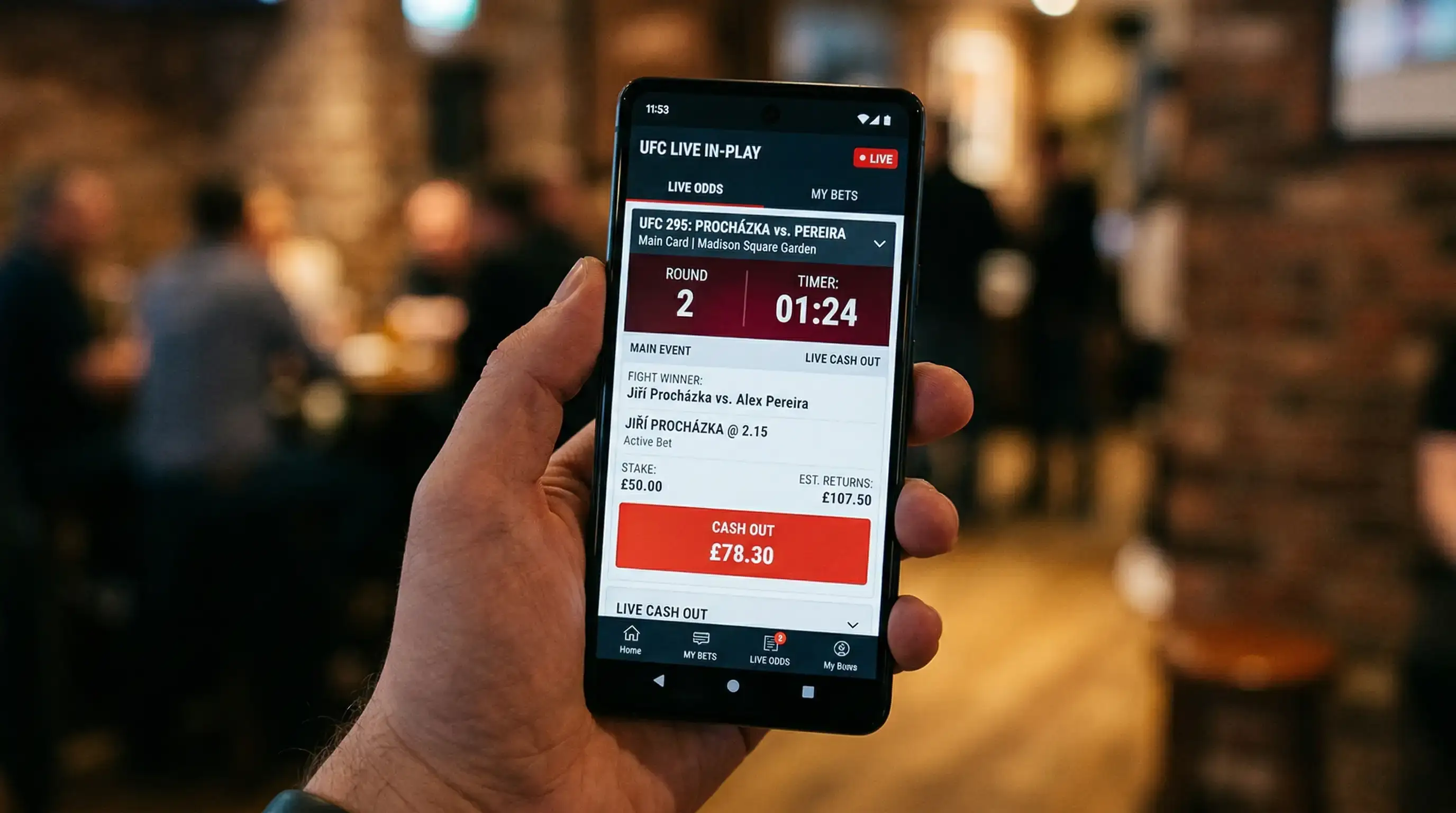
Cash-out is the feature every UK book markets heavily and every sharp bettor treats with suspicion. The mechanic is simple: at any point during a live UFC event, the book will offer to buy back your pending bet at a price that reflects the current probability of the bet winning, discounted by cash-out margin. You accept, the book settles early at the offered amount, and the pre-fight bet is closed regardless of how the fight subsequently resolves.
The arithmetic is where British punters get in trouble. If you backed Fighter A at decimal 3.0 (33.3% implied) for £10 pre-fight, and Fighter A has controlled the first round such that the book’s live probability estimate is now 55%, the fair cash-out value on your £10 stake is £16.50 of total expected value (55% × £30 = £16.50). The actual cash-out offered by a UK book on that position will typically run £14-£15, depending on the book’s cash-out margin. That margin is a real cost, and it is rarely disclosed as a percentage on the slip — you have to infer it from the difference between fair value and offered value.
The structural reason cash-out exists is that UK books profit when customers take it. Bet365’s overall pre-fight margin on major UFC bouts sits around 4%, but the effective margin on cashed-out positions routinely runs 10% or higher once you combine original pre-fight margin with cash-out discount. For the book, cash-out is a revenue-generation tool; for the customer, it is an insurance product. Whether the insurance is worth the premium depends entirely on the specific situation.
Cash-out genuinely helps in three specific scenarios. First, when your original stake size was too large for your bankroll and a cash-out lets you de-risk a position that should not have been placed at current size anyway. Second, when the in-cage situation has changed materially in ways your original fight read did not account for — an injury, a late-round gas tank reveal, a tactical adjustment that undermines your thesis — and cashing out is a legitimate recognition that the original bet is no longer the bet you would have made with current information. Third, when a cash-out locks in a profit you have practical use for in the short term and the marginal additional expected value of letting the bet run is smaller than the utility of the cash now.
Cash-out hurts in the inverse situations. When your original read was sound and nothing has meaningfully changed, the cash-out offer is just the book buying back positive expected value at a discount, and accepting it systematically over time produces negative returns. When your anxiety about a pending bet is driving the cash-out decision rather than updated information, the book is monetising your emotional state rather than any genuine re-evaluation. Chad Yeomans of Betway framed one of the underlying dynamics of bookmaker pricing when commenting on an unusual run of results: “Obviously, for bookmakers, it was a Cheltenham to remember. It’s very rare that so many well fancied shots get beaten, so there was definitely no moaning from our side.” The mirror image applies to cash-out — books are pleased whenever a customer cashes out of a position that was tracking toward a payout, and the pleasure is proportional to the margin extracted.
The rule I apply to cash-out is simple: cash out only when I would not place the same bet again at the same stake with the current fight information. If I would still place it, letting it ride is the higher-expected-value decision. If I would not, the cash-out is a rational closing of a position that has stopped being the trade I wanted. That test eliminates most emotionally driven cash-outs and preserves the ones that reflect genuine situational reassessment.
Track real-time odds fluctuations and expert insights directly on the mma Betting Online homepage.
Live Props: Next Significant Strike, Takedown, Round Winner
In-play prop markets are the deepest and narrowest slice of live UFC betting on UK slips. They unlock in short windows, price rapidly against the current fight state, and reward punters who can read the next thirty seconds of cage action more accurately than the book’s model can. The reason they are priced rapidly rather than reliably is the base-rate reality of UFC outcomes — favourites win 72% of fights in recent data, upsets run 30% across priced matchups and climb to 40% on co-main events, and the distribution of finishes across rounds is genuinely hard to model round-by-round in real time.
The core prop families on British slips are next-action, round-outcome, and fighter-specific. Next-action props include “next significant strike by Fighter A” and “next takedown by either fighter” — short-horizon markets that settle within the next minute or two of action. Round-outcome props cover “Fighter A wins round 2”, “round 2 ends inside the distance” and “round 2 produces a knockdown”. Fighter-specific props track accumulators on a single fighter — “Fighter A lands 20+ significant strikes this round”, “Fighter A scores a takedown this round”, “Fighter A is warned by the referee”.
The information asymmetry I described in the between-rounds section applies with greater intensity to live props. Your visual read on the fighters — who is breathing harder, whose jab is finding range, who has committed to a specific tactical pattern — is information the book’s data feed does not carry. If you can translate that visual read into a prop bet inside the window before the book’s model catches up, you have edge. If you cannot, the prop is just a high-margin market with narrow settlement.
The margin on live props is wide. Where moneyline might be priced at 5–7% overround in-play on a UK book, individual props frequently run 10–15% margin and sometimes higher on fighter-specific markets with thin liquidity. That margin compounds across a multi-prop session, and it is the main reason casual UK punters who chase live props without a disciplined method tend to lose faster than casual punters on moneyline.
The disciplined method has three elements. Narrow your watch list to two or three fights on the card where you have genuine tape knowledge. Watch those fights without placing any live bets for the first round, to calibrate the book’s pricing against the actual cage action. Place in the second or third round only when you see a specific situation your tape knowledge suggests is mispriced. That protocol concentrates your in-play prop activity into the small minority of fights where you have an information advantage, rather than spreading small stakes across every prop that catches your eye.
The Latency Problem: Stream vs Cage Clock
TNT Sports is the exclusive UFC broadcaster in the UK and Ireland, with pay-per-view cards distributed through TNT Sports Box Office and HBO Max, and UFC Fight Pass handling archives. That exclusive relationship is where British UFC betting collides with one of the deepest operational problems in live sports betting — the latency gap between what you see on a stream and what has already happened in the cage.
The technical chain behind any UK UFC broadcast runs from the cage camera through production, satellite or fibre uplink, broadcaster distribution, regional transmission and finally your home device. That chain introduces latency at every stage. A live TNT Sports feed on cable typically runs four to eight seconds behind the actual cage clock. Streaming through HBO Max or the TNT Sports app can add another two to five seconds. Over-the-top smart TV apps can add more. The total latency for a British viewer can run ten to fifteen seconds, occasionally more on the slowest streaming paths.
The book’s data feed, by contrast, runs much closer to real-time. Official UFC data partners push cage events to operator pricing systems within two to five seconds of occurrence, and the book’s in-play pricing updates against that near-real-time feed. The result is that the book knows what has happened in the cage several seconds before you see it on your stream, and the prices you are looking at already reflect events your eyes have not yet registered.
The practical consequence is brutal for casual live bettors. If a fighter takes a clean knockdown at 2:14 of round 2, the book’s feed shows that at roughly 2:14 or 2:15, the pricing model updates, the markets suspend, and when they reopen the odds reflect the knockdown. Your stream shows the knockdown at 2:22 or later. By the time you see it and try to place a bet on the recovered fighter, the markets have already repriced and the window closed seconds before your screen even caught up. You are consistently placing bets on a cage state that no longer exists.
The mitigation options for British viewers are limited but real. Lower-latency streaming paths — broadcast cable TV over a direct provider connection tends to have the shortest chain, and some streaming setups offer “low latency mode” toggles that sacrifice video quality for reduced delay. Radio or live audio commentary, where available, typically runs closer to cage time than video. And the most important mitigation is simply awareness — knowing that any live price you see has been formed against information slightly ahead of your visual feed, and discounting your in-play reads accordingly.
The sharper British in-play bettors I know treat latency as a hard constraint on their live strategy. They do not chase quick reactions to visible cage events because the book has always already reacted. They focus instead on longer-horizon tactical reads — cardio patterns, emerging stylistic adjustments, corner-signalled strategy shifts — that do not require beating the data feed. That shift in approach is the difference between live betting as a sustainable discipline and live betting as a lossy casino format.
Discipline for Live MMA Betting: Hard Rules
Ted Orme-Claye of SBC News put his finger on a wider problem that applies as directly to in-play betting as it does to harm measurement: “Perhaps the Commission and the NHS could come up with a way to standardise this a bit better so we have a more decisive conclusion about what the problem gambling rate actually is.” The underlying point — that loose methodology produces bad outcomes — transfers cleanly to individual live betting discipline. Loose rules produce losses.
My personal rules for live UFC betting are five. First, set a live session budget separately from your pre-fight stakes, and stop when it is gone regardless of what is happening on the card. Second, never place a live bet in the first thirty seconds after a significant cage event — the market suspension and repricing window is exactly when casual money trades badly. Third, cap the number of live bets per fight at two or three, to prevent the cascade of small impulsive bets that live betting encourages. Fourth, never let a live bet ride past its intended resolution window — if you backed “round 2 to produce a knockdown” and round 2 ends without one, close the day’s exposure to that fight. Fifth, log every live bet with the same CLV-style tracking you apply to pre-fight — in-play bets have closing lines too, in the form of the price the market settled at before resolution, and tracking them is the only way to know whether your live reads are actually adding value.
Those rules exist because live UFC betting on UK slips is the single highest-margin, highest-variance, highest-engagement product any British bookmaker offers you. All three characteristics compound: high margin drains bankroll faster than pre-fight, high variance means your result is noisier than pre-fight, and high engagement means you place more bets per unit time than pre-fight. Discipline is the only structural defence, and the five rules above are the operational expression of it. The wider principles around UFC odds and value betting for UK punters apply in-play just as they do pre-fight; the execution environment just makes them harder to maintain.
Why do UFC live odds suspend in the middle of a round on UK sites?
UK books suspend live markets whenever the in-cage state becomes uncertain enough that their pricing model cannot confidently publish odds — significant strikes landing, knockdowns, takedowns, submission attempts, active scrambles. Suspension typically lasts from a few seconds for minor events up to the rest of the round for near-finishes. Existing bets are unaffected; only new placements and cash-out requests are blocked until the market reopens at repriced odds.
Is cash-out value ever better than letting a UFC bet run on UK books?
Only when the information behind your original bet has materially changed, or when the stake is too large for your bankroll. UK book cash-out values carry a margin discount above and beyond the standard in-play overround, so systematically cashing out positive-expected-value positions loses money over time. The useful test is whether you would still place the same bet with the current information — if yes, let it ride; if no, the cash-out is rational.
What stream latency should I expect between UK TNT Sports and the cage?
Broadcast cable typically runs four to eight seconds behind actual cage time. Streaming via HBO Max or the TNT Sports app often adds two to five seconds, sometimes more on slower connections — total latency of ten to fifteen seconds is common. UK book pricing feeds run much closer to real-time, so live prices reflect events your stream has not yet shown. Plan live bets around longer-horizon reads rather than rapid reactions.
Do UK bookmakers offer live between-rounds markets for PFL or Bellator?
Most UKGC-licensed books offer some live markets on PFL and Bellator cards but with materially less depth than UFC. Expect moneyline and round-winner markets live, with limited props and shorter between-rounds windows. KSW, Oktagon and Cage Warriors cards have even thinner in-play menus. Live-market depth scales roughly with pre-fight liquidity, and UFC sits at the top of that spectrum by a wide margin.
Published by the mma Betting Online team.